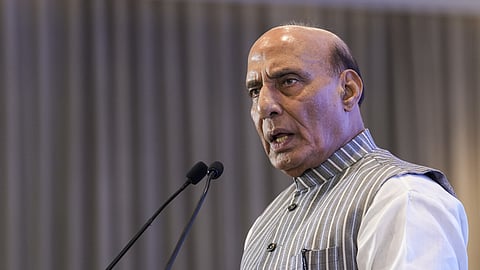

NEW DELHI: Defence Minister Rajnath Singh on Friday underscored the significance of innovation in defence to deal with the metamorphosing unconventional warfare.
Rajnath Singh termed the adoption of unconventional ideas, not yet known to the world, as the only way to progress in unconventional warfare. He was addressing scientists, industry leaders, academia, start-ups, MSMEs and young entrepreneurs during Twaral, a DRDO-Industry Workshop on Defence Technology Acceleration organised at DRDO Bhawan in New Delhi on Friday. On the occasion, not only technology developed under the Technology Development Fund (TDF) was handed over to the users, but challenges in finding solutions in the defence sector were also launched.
Sharing insights on the transformation of the defence sector in the recent past, the Defence Minister stated that, today, technology has transformed conventional warfare into unconventional warfare.
"New dimensions have been added to modern-day warfare such as drones, cyber warfare, bio-weapons and space defence. In this transformative phase, R&D in defence will make the defence sector stronger. It is heartening to witness our scientists, industrialists, academia, start-ups, MSMEs and young entrepreneurs working together in this endeavour. It is time for the private sector to take the lead as it has the ability to absorb rapid changes and create new innovations," he said.
The Defence Minister reiterated the government's commitment to make the defence sector more innovative and technology-oriented. Highlighting the consistent efforts being made by DRDO to strengthen the R&D environment and promote the scientific temperament, he said, "Technology Development Fund (TDF) scheme is providing up to 90% of the total project cost as grant support to eligible industries. The total support is up to Rs 50 crore, a good amount for any MSME and start-up to invest in defence R&D. Since its launch six years ago, 79 projects have been sanctioned, of which, technology has successfully been developed in 18 projects."
As part of the event, Rajnath Singh launched 'Dare to Dream 5.0' to encourage the next generation of innovators & start-ups to come forward with transformative ideas for defence applications. The fifth edition of DRDO's innovation contest aims to generate cutting-edge solutions for India to progress further in its pursuit to achieve 'Aatmanirbharta' in defence technologies.
The Defence Minister also felicitated the winners of 'Dare to Dream 4.0', recognising individual innovators, start-ups and MSMEs for disruptive solutions and innovations in the fields of countermeasures for drones and swarm of drones; advanced acoustic systems to locate gunfire, directed energy technologies, cognitive listening device, target seeking & proximity sensing, free-space laser communication system, multi-terrain multi-utility robot among others.
The Defence Minister emphasised on the need to achieve advancements in both incremental and disruptive technologies within the defence sector. The solutions to challenges obtained through initiatives such as 'Dare to Dream' bridge the critical gap between the two types of technologies, he said.
Several challenges on Disruptive, Emerging, Enabling and Pioneering Technologies (Deep-Tech) were also launched to drive major advancements in areas critical to the country's defence infrastructure. The focus on Deep-Tech emphasises the need for India to develop and harness breakthrough technologies to stay at the forefront of defence innovation.
The challenges are:
Compact Electromechanical Actuators;
Development of indigenous thrusters for Yard Craft (Indian Navy);
Development of High Purity Silicon Carbide source powder for the bulk growth of SiC single crystal;
Deep-Tech for HPM Counter Measures and Protection;
Development of a Digital Twin Framework for Aero Gas Turbine Engine Health & Usage Monitoring.
Several cutting-edge indigenous technologies developed under the TDF scheme were also handed over to the users, including DRDO and the Armed Forces, in the presence of Rajnath Singh. These innovations, created by startups and MSMEs with DRDO, mark a significant step in the country's journey towards self-reliance, enhancing national security.
The technologies included Autonomous Drone as first responders for search and report missions in enclosed/indoor environments, Simulator for Unmanned Ground, Marine (Sea Surface and Underwater) and Aerial Vehicles, Data Assessment Active Learning and Believability for Visual Data and Fuel System Temperature Transducer for Aircraft Application by Tejase Aeroscience Private Ltd Mumbai to ADA.
The DRDO-Industry Workshop on Defence Technology Acceleration brought together all the stakeholders of the innovation ecosystem to explore strategies for expediting the development of critical defence technologies. The discussions were centred on bridging the gap between research efforts and real-world applications, with a strong focus on collaboration across sectors. Setting the foundation for future innovations, the workshop underscored the critical role of DeepTech (R&D) in advancing national security capabilities.
The Amended Standard Operating Procedures for TDF, aimed at simplifying the process for start-ups and MSMEs to collaborate with DRDO, was also released. These updated procedures are designed to foster a more transparent and streamlined approach for innovators, enabling easier access to opportunities for contributing to national defense projects.
