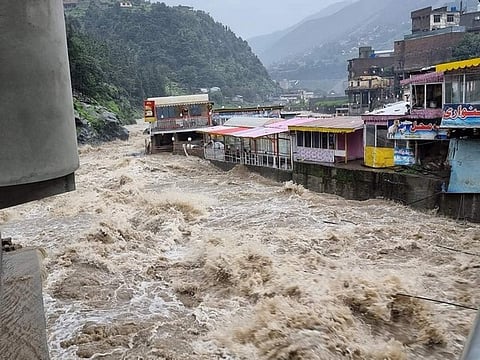

NEW DELHI: A new study of the World Bank has revealed that India’s smaller business firms and poor households experience higher levels of climate change-induced extreme heat and flood than better-off ones. It leads to a continuous trap of poverty and puts challenges to economic growth in developing nations.
Extreme heat is associated with high morbidity and mortality, worsened performance among students as schools close down, reduced agricultural productivity, and costly migration. Floods are associated with loss of properties and damage of agricultural crops.
The study found that poorer neighbourhoods in cities and rural areas in India are more exposed to heat and floods. It says the Relative Wealth Index (RWI) — prediction of the relative standard of living within countries — data shows that places with lower RWI in urban and rural areas experience higher temperature and flood.
The research paper ‘Household and Firm Exposure to Heat and Floods in South Asia’ examines the differential exposure of poorer households to heat and floods in South Asia.
It points out that non-agricultural firms in India, which are smaller and informal, are more exposed to floods and heat than larger firms. Also, the employees are lesser at warmer places than relatively cooler places.
On an average, places with an average temperature of 33°C have 0.25 fewer employees, about 12.5% smaller, than a place with an average temperature of 31°C.

It points out that extreme heat exposure between rich and poor areas is uneven in rural and urban areas. The impact of extreme heat is more pronounced in urban than rural areas.
However, the relationship between exposure to flooding and wealth is relatively complex. In urban areas, poorer are more exposed to flooding risk, whereas in rural settings the richer are at higher risk.
The study explains that these differences are due to intensity of exposure of floods rather than exposure to regular flooding at all. It states there is not much difference in wealth across places that experience floods compared to no flooding. But its impact is of lesser magnitude compared to extreme heat.
Meanwhile, wealthier individuals have capacity to move away to desirable climates so get lesser exposure to climate hazards. But repeated exposure to climate hazards may reduce individuals’ capacity to migrate away from at-risk locations. Repeated exposure can directly reduce incomes and, consequently, wealth levels in these impacted areas.
The study used spatially detailed data on climate shocks and relative wealth allows the analysis in this paper to capture highly localised variation in wealth, heat and floods.