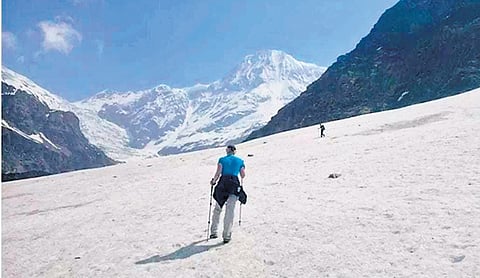

DEHRADUN: The Pindari glacier in the upper Himalayas has retreated significantly, sparking concerns about the impact of global warming on Uttarakhand’s environment and tourism industry.
“The Pindari glacier has retreated by more than half a kilometer in the last 60 years,” said Padma Shri awardee Anoop Sah, a member of the Uttarakhand State Wildlife Board, after his recent visit to the glacier. Researchers at the Wadia Institute of Himalayan Geology have corroborated Sah’s statement through their studies. “It’s true that the glacier has retreated. This is a continuous process, and glaciers can also regain their original form,” Manish Mehta, a glaciologist at the Wadia Institute, told this newspaper.
“Glaciers are dynamic systems, and their retreat or advancement is a natural phenomenon. However, human activities and climate change can exacerbate the process,” he said.
Sah said, “In 1964, when I first ventured to Pindari glacier, the Zero Point was blanketed with snow. Now, all that’s left are barren, crumbling mountains.” Sah and fellow explorer Dhirendra Bist embarked on their latest journey to the glacier from Ranikhet on October 16, reaching Zero Point on October 20. Returning to Nainital on Thursday, they shared their experiences.
“The receding glaciers are having a devastating impact on the region’s wildlife. Species like the Himalayan tahr, blue sheep, sambar, ghural, kakar, satyr, tragopan, monal, and hill peafowl, once abundant, are now rarely spotted,” Shah said. Bist said, “The disappearance of glaciers has forced animals like snow leopards and bears to venture into human settlements, attacking shepherds’ sheep and horses.”
The explorers highlighted the alarming shift in the region’s vegetation, with rare herbs like salam panja, salam mishri, atis, and kutki becoming increasingly scarce. “This ecological imbalance threatens the very survival of the Himalayan ecosystem,” Sah emphasised. “Immediate action is necessary to mitigate the effects of climate change and preserve this fragile environment.”
Sah and Bist expressed concern over the harmful impact of construction on Himalayan glaciers. During their recent expedition, Sah observed extensive use of cement and concrete on trekking routes, posing a significant threat to glacier health. “Cement and concrete are detrimental to glaciers. Instead, local resources like bamboo and ringal should be utilised for construction, preserving the glacier’s integrity and the region’s natural beauty,” Sah said.
“I’ve trekked to Pindari Glacier 11 times, traversing Trail Pass in 1994, Baljuri Peak in 1972 and 2023, and Nanda Khat in 1972. Our expeditions highlight the Himalayas’ majesty and fragility. It’s crucial we preserve this ecosystem for future generations,” he said.
Uttarakhand, renowned for its breathtaking natural beauty, is witnessing the impact of global warming. Pindari glacier, one of the state’s iconic landmarks, is among the latest casualties.
