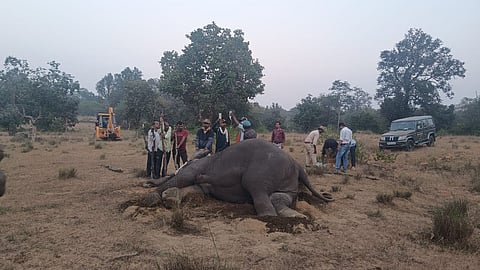

BHOPAL: Four wild elephants (three females and one male) were found dead in the core jungle area of Bandhavgarh Tiger Reserve (BTR) under Umaria district of Madhya Pradesh on Tuesday.
The four tuskers were part of a 13-strong herd. The health of at least five other elephants from the same herd is reportedly in very bad shape wherein they are unable to stand.
A team of veterinary specialists were rushed to render emergency medical care to the ill jumbos, along with a team of forensic experts from the School of Wildlife Forensic and Health, Jabalpur. This was confirmed by an official statement from the Madhya Pradesh forest department’s principal chief conservator of forest (PCCF-Wildlife).
Further, a team of the Madhya Pradesh forest department’s State Tiger Strike Force (STSF) – the wildlife crime investigation arm of the forest department – has also rushed to the Bandhavgarh Tiger Reserve to examine the animals' death.
Primary investigation by the BTR management suggests the possibility of the elephants having consumed a large amount of standing Kodo-Kutki crop (millet grains used as rice), which could have led to food poisoning.
The state forest department higher-ups in Bhopal said that a detailed on-the-spot probe will only lead to ascertain the real cause of the incident.
However, Bhopal-based wildlife and RTI activist Ajay Dubey, demanded a magisterial probe into the incident. He suspects that heavy use of pesticide in the standing crop, particularly paddy which was possibly consumed by the elephants, may have led to food poisoning.
The incident came to light at around 4 pm on Tuesday, when THE Bandhavgarh Tiger Reserve patrolling teams found three tuskers lying in Salkhaniya-Charakvar jungles under the Khitauli range’s core area.
Intensifying the patrolling further led the team to find another elephant in similar condition a short distance away and five other elephants in extremely bad shape. Vets were immediately pressed into action, after which it was established that four elephants had died, while the health of five other elephants was deteriorating fast.
While confirming the entire development to The New Indian Express, the MP Forest Department’s additional principal chief conservator of forest (APCCF-Wildlife) L Krishnamurthy said, “It will be premature to comment right now about the reason behind the deaths of the four elephants and health deterioration of five others of the common herd. Our vets are already there, while experts from the School of Wildlife Forensic and Health in Jabalpur too are being rushed to the spot. An STSF team from Bhopal too is on its way to probe the incident. Further, our combing teams are already searching in the area in connection with the incident.”
Experts from the Wildlife Institute of India (WII-Dehradun) are also in touch with the MP state forest department.
Bhopal-based wildlife and RTI activist Ajay Dubey, however, suspected major poisoning of elephants through the use of pesticides in the standing paddy crop or the millet crop in the nearby villages. “This is the first case of so many elephants losing their lives in a small jungle patch while simultaneously, many others of the same herd are in a critical state. Deaths are possible due to electrocution or rail hits and sporadic cases of poisoning. But so many elephants getting killed simultaneously feels like a bigger conspiracy,” he shared.
"My demand to the CM Dr Mohan Yadav is to institute a high-level probe as to how this major killing happened. Was the paddy or any other crop from where the elephants returned sprayed with an extremely high dose of pesticide? This mass killing shouldn’t be probed by only the forest department. Since it could be linked to the excessive use of pesticides in the area, the Umaria district administration should institute a thorough magisterial probe,” stressed Dubey.
Importantly, the Bandhavgarh Tiger Reserve which houses the densest population of tigers in MP, has become home to a big herd of wild elephants since 2018.
More than 50 elephants originating from the neighbouring district of Chhattisgarh, have reportedly made the Bandhavgarh Tiger Reserve their permanent habitat. The same area of eastern MP, particularly Shahdol and Anuppur districts have reported growing cases of man-elephant conflicts in the wake of wild herds from Chhattisgarh often damaging their crops.
The Tuesday afternoon death of the wild jumbos in the core area of Bandhavgarh Tiger Reserve, particularly assumes significance, as the same reserve was in the news some months back due to the rising mortality of tigers.
The National Tiger Conservation Authority (NTCA) had ordered a probe into the tiger deaths there. A committee comprising experts, among them the officer in charge of STSF, had probed the deaths at BTR subsequently and found some grave anomalies.