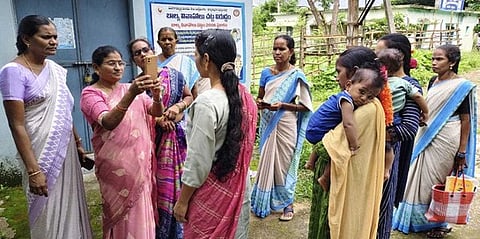

NEW DELHI: The Centre has completed face capturing for 75.12% of eligible beneficiaries registered for ‘Take Home Ration’ at Anganwadi centres, the Lok Sabha was informed on Friday.
The Ministry of Women and Child Development has made the face recognition system for take-home ration distribution and child attendance monitoring at Anganwadi centres mandatory from 1 July.
The Face Recognition System (FRS) module was initially implemented as a pilot in August 2024. Since then, duty holders in the states and Union Territories have allegedly been trained to perform facial recognition and verify beneficiaries with the Aadhaar database, Minister of State for Women and Child Development, Savitri Thakur, said in a written reply.
This onboarding process is performed once in the lifetime of the beneficiary on Poshan Tracker.
She said the FRS module has been developed as part of the Poshan Tracker application. To verify a beneficiary through Aadhaar identification, eKYC is performed along with capturing the live image of the beneficiary.
“As on 5 August 2025, face capturing and e-KYC of 3.69 crore beneficiaries out of the 4.91 crore eligible beneficiaries registered for Take Home Ration (THR), which is almost 75.12%, have already been completed,” she said.
On data protection of beneficiaries, she said the data of the beneficiary, which is collected, is subject to all existing data protection protocols, which mandate purpose limitation, informed consent, and access restrictions.
“All requests and responses related to Face Verification are encrypted during transit, ensuring data is protected from interception or tampering. No images or data are stored permanently on the device. As a precautionary measure, all cached or temporary data is wiped automatically when the Anganwadi worker logs out of the application,” she said.
The minister added that the private data is not publicly accessible and is available only to authorised personnel solely for verification purposes. The Poshan Tracker application is typically used by Anganwadi workers and is not open to the public or any unauthorised party. Access is role-based, logged, and monitored to prevent misuse.
Further, the application’s internal database is encrypted, preventing access to sensitive information outside the app environment. Face images are handled in encoded format within the app to ensure safe processing and transmission.
She said that for availing benefits of take-home ration on a monthly basis, face matching can be performed both in online and offline mode and no repeated eKYC is required.
The offline mode feature has been developed keeping in consideration areas with low digital connectivity. The facial recognition feature has also been made compatible for low-end version phones.
Bal Aadhaar for children under five years of age does not contain any biometric data; therefore, for children aged up to six years, the FRS of the mother, father, or guardian is being done and not that of the child.
She further said that under the 15th Finance Commission, various components like Anganwadi services, Poshan Abhiyaan, and the scheme for adolescent girls (aged 14-18 years in aspirational districts and the North-Eastern region) have been subsumed under the umbrella Mission Saksham Anganwadi and Poshan 2.0 (Mission Poshan 2.0) to address the challenge of malnutrition.
It is a centrally sponsored mission, where the responsibility for implementation of various activities lies with the states and UTs. “This mission is a universal self-selecting umbrella scheme where there are no entry barriers for any beneficiary to register and receive services,” Thakur said.
Under this mission, supplementary nutrition is provided to children (six months to six years), pregnant women, lactating mothers, and adolescent girls to break the intergenerational cycle of malnutrition by adopting a life cycle approach.
Supplementary nutrition is provided in accordance with the nutrition norms contained in Schedule II of the National Food Security Act. These norms were revised in January 2023.
The old norms were largely calorie-specific; however, the revised norms are more comprehensive and balanced in terms of both quantity and quality of supplementary nutrition, based on the principles of diet diversity that provide for quality protein, healthy fats, and micronutrients.
