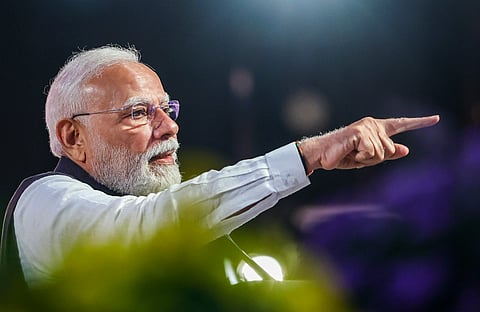

BENGALURU: Prime Minister Narendra Modi said the success of India’s forces in Operation Sindoor, which destroyed terrorist hideouts deep across the border, was due to India’s technological prowess and the strength of the ‘Make in India’ initiative in defence.
He said the success of the operation had shown a “New India” to the world, emphasising India’s strength in forcing Pakistan, which came to defend the terrorists, to its knees within hours. Modi added that Bengaluru and Karnataka had contributed significantly to the success of the operation.
He was speaking at the foundation stone-laying ceremony of the Bengaluru Metro Phase-3 (Orange Line) project, worth over Rs 15,610 crore, in the city on Sunday.
Addressing the audience after laying the foundation, Modi said, “I am coming to Bengaluru for the first time after Operation Sindoor. The success of the operation has shown a New India to the entire world. A major factor behind the victory of the operation is the indigenous technology and the might of Make in India in defence. There is a lot of contribution towards this from the youth of Bengaluru and Karnataka. I congratulate them for their contributions.”
Earlier, amidst chants of “Modi, Modi”, the Prime Minister, who began his speech in Kannada, said that Bengaluru had become a symbol of New India and that it had “philosophical knowledge” in its soul and “tech knowledge” in its action.
“Bengaluru has put India on the global tech map. The talent and the contribution of the people of Bengaluru to this success is immense,” Modi said, adding that “urban planning” and “urban infrastructure” are essential for cities like Bengaluru, and that the city is prepared for the future.
He said that the Bengaluru Metro’s Yellow Line had been inaugurated along with three Vande Bharat trains. “The Yellow Line connecting RV Road to Bommasandra will connect key areas in Bengaluru, reducing the travel time between Basavangudi and Electronic City,” Modi said, adding that this would enhance ease of living and ease of working.
Modi said the newly inaugurated Yellow Line, along with the Orange Line, for which he laid the foundation, would facilitate the travel of 25 lakh passengers and empower Bengaluru’s transport system, scaling it to new heights.
He noted that the Bengaluru Metro had introduced a new model for public infrastructure development in the country and highlighted the CSR contributions of companies like Infosys, Biocon, and Delta Electronics. He praised the corporates for the innovative use of CSR, saying it was an inspiration.
He recalled that in 2014, metro services in India were limited to just five cities, whereas today the network spans over 1,000 kilometres across 24 cities, making India the third-largest metro network globally.
He also pointed out that from independence till 2014, only 20,000 km of rail network was electrified, whereas from 2014 till now, over 40,000 km of routes have been electrified, calling it a significant step towards sustainable transport development.
Chief Minister Siddaramaiah, in his speech, said, “Works for the Bengaluru Metro started in 2005 when Dr Manmohan Singh was the Prime Minister, and the agreement was to take up works in a 50:50 fund ratio. However, the state’s contribution to building the metro is high.”
He concluded by requesting the Central Government to fund Karnataka in the same manner as states like Maharashtra and Gujarat.
In reply, during his speech, PM Modi called for collaborative efforts to improve the lives of citizens, saying, “Whether it is the central government or the state government, all are committed to serving the people.”
Union Railway Minister Ashwini Vaishnaw said that Karnataka’s annual railway budget allocation before 2014 was Rs 835 crore, and in 2025 it is Rs 7,564 crore. He said the total investment in Karnataka’s rail network is Rs 54,000 crore.
Karnataka Governor Thawarchand Gehlot, Deputy Chief Minister DK Shivakumar, and others were present.