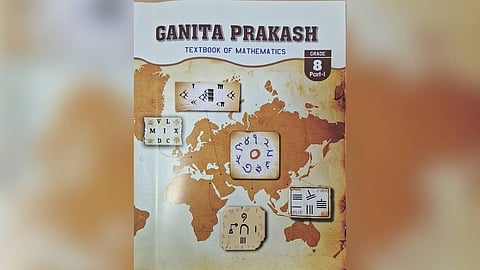

NEW DELHI: The subject of Mathematics creates a great deal of anxiety or dislike in a large section of students. But, it is creative, exciting and an interesting adventure, as proved by the National Council of Educational Research and Training (NCERT) latest textbook on the subject.
Ganita Prakash, the Part-1 textbook for Class 8, made public recently, is aligned with the National Education Policy – 2020 and the National Curriculum Framework for School Education (NCFSE) 2022-2023.
It is one of the parts of the series for the Middle Stage (Grades 6 to 8), that serves as a critical bridge between the preparatory and secondary stages.
Setting the tone of the book's objective right at the outset, a note to students states, "To be able to appreciate the art of mathematics, it is not enough to just be a passive spectator. You need to immerse yourself in its process like a detective getting into action to solve a mystery."
An owl mascot pops up frequently among the pages to highlight important mathematical processes and problem-solving approaches.
Contextual examples and thought-provoking queries are featured in the book. For instance, to explain the concept of rapid exponential growth, a rhetorical query is posed to the student: How many times should a paper be folded over and over to reach the Moon?
Similarly, to help the student understand ratios and proportions, Chapter 7 draws upon a simple topic: What is the mathematics behind making a strong coffee?
Hardy-Ramanujam number
The Hardy-Ramanujam number 1729 is fantastically explained.
Accompanied by an illustration of the renowned British mathematician G H Hardy visiting India’s genius Ramanujam in the hospital when he fell sick once, the book narrates that Hardy had arrived in a taxicab numbered 1729.
The conversation between them is narrated with Hardy making a remark that 1729 was "rather a dull number."
Pat comes to Ramanujam’s response: "No Hardy, it is a very interesting number. It is the smallest number that can be expressed as the sum of two cubes in two different ways."
1729 = 13 + 123
=93 + 103
Because of the story, 1729 has ever since been known only as the Hardy-Ramanujam number, the text explains.
An exclusive chapter on, A Story of Numbers, explains the robustness of ‘0’ (zero) in the Hindu numbering system, which was in existence as early as 200 BCE.
Zero is unique and does not have any ambiguity. The lesson takes the student down the historical lane by elaborating the number systems in civilisations across the world, including the Roman, Egyptian, Babylonian, Mayan and the Chinese accompanied by detailed illustrations.
Perfect squares and perfect cubes were compiled by the Babylonians way back in 1700 BCE, it points out.
To explain root numbers, the book highlights interesting daily stats: "The time needed to digest a meal -- about 2 to 4 hours. In root numbers, it is shown as 2.7 hours = 104. Time spent in sleep annually - about 4 months. In mathematical language, it would be 115.7 days =107"
The contributions of mathematician-astronomers Aryabhata, Aryabhata-II and Brahmagupta are also well highlighted to help students understand the strong background India had in the subject.
