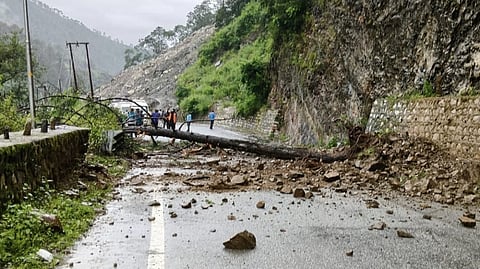

DEHRADUN: Unchecked human intervention in sensitive Himalayan states like Uttarakhand is ringing alarm bells for nature, transforming pristine beauty into a breeding ground for disaster. Rapid, uncontrolled construction in these ecologically fragile mountainous regions, rich in natural beauty and biodiversity, is not merely disturbing the environmental balance but is now directly fuelling a surge in natural calamities.
Senior scientists at Nainital's Aryabhatta Research Institute of Observational Sciences (ARIES) assert that the haphazard construction of buildings and roads is profoundly impacting the delicate Himalayan ecosystem.
Experts explain that mountain soil is inherently fragile. Large-scale excavation and construction not only diminish the soil's natural water retention capacity but also destabilise the delicate climatic system. This disturbance is having a direct and alarming impact on regional weather patterns.
Notably, there's been a significant increase in 'local cloud formation' – an unusual accumulation of clouds at lower altitudes in mountainous areas. These low-lying clouds are prone to sudden, intense bursts of rainfall, leading to a surge in devastating cloudburst incidents.

Narendra Singh, a meteorologist at ARIES, elaborated on the unseen impacts. "Construction activities affect nature not just visibly, but invisibly too," he told TNIE. "Every building emits radiation, which returns to the atmosphere, contributing to a rise in temperature. Areas with extensive construction typically record higher average temperatures compared to their surrounding regions."
Dr. Singh further claimed that this localised temperature increase fundamentally alters the dynamics of cloud formation and precipitation.
"The combined impact of global warming, rampant deforestation, and unchecked construction is now starkly evident across the Himalayas," Dr. Singh stated.
"Where clouds once took months to form, delivering gentle, sustained rainfall, they now gather within hours, unleashing devastating deluges."
Scientists have issued a grave warning: if the current pace of unsustainable development continues, incidents of cloudbursts and landslides in Uttarakhand and other Himalayan states could multiply manifold in the coming years.
Local environmentalists echo these concerns, asserting that it is imperative to strike a critical balance between development and ecological preservation.
They advocate for meticulously planned and sustainable construction practices, robust forest conservation efforts, and stringent controls on building activities in fragile mountainous regions as the only viable path to avert this looming crisis.