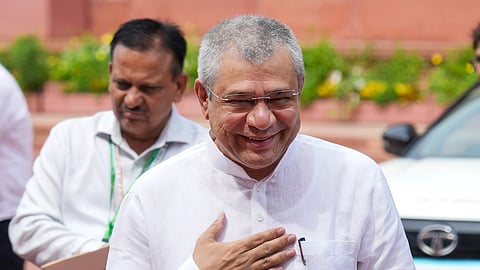

The Union Cabinet on Tuesday approved several projects, including four semiconductor plants for Odisha, Punjab and Andhra Pradesh, the Phase-IB of the Lucknow Metro project and a 700 MW Tato-II hydro-electric project in Arunachal Pradesh.
The Cabinet meeting was chaired by Prime Minister Narendra Modi.
Under the India Semiconductor Mission, which has an outlay of Rs 76,000 crore to provide financial support for setting up chip facilities in the country, the government has approved four semiconductor projects entailing Rs 4,594 crore investment in the three states.
According to Information & Broadcasting Minister Ashwini Vaishnaw, a silicon carbide semiconductor plant will be set up in Bhubaneswar with an investment of Rs 2,066 crore by SiCsem Pvt Ltd.
Another plant in the state will be set up for 3D Glass manufacturing with an investment of Rs 1,943 crore.
The minister said that the 3D Glass semiconductor plant will be backed by investment from leading US technology firm Intel, Lockheed Martin, etc.
The Cabinet approved a chip packaging plant in Andhra Pradesh, which will be set up by Advanced System in Package Technologies Pvt Ltd with an investment of Rs 468 crore.
A semiconductor project of electronic component maker firm CDIL, to be set up in Punjab with an investment of Rs 117 crore, has been approved, the minister stated.
Phase-IB of Lucknow Metro project
The government also approved the Phase-IB of the Lucknow Metro project with a corridor length of 11.165 km at a cost of Rs 5,801 crore.
According to the government, on operationalisation of Phase-1B, Lucknow will have 34 km of active Metro rail network.
In a statement, the government said that Phase-1B of the Lucknow Metro Rail Project represents a significant advancement in the city's infrastructure development, marking a major expansion of the Metro rail network in the state capital.
The new corridor will introduce approximately 11.165 km of new Metro lines with 12 stations -- seven underground and five elevated -- improving public transportation in the oldest and the most densely-populated areas of the city, which currently lack efficient connectivity, the statement said.
This phase aims to seamlessly integrate the key zones of Old Lucknow, including commercial hubs such as Aminabad, Yahiyaganj, Pandeyganj and Chowk, it said.
It will also integrate the other key zones such as the King George's Medical University (Medical College) and major tourist attractions such as Bara Imambara, Chota Imambara, Bhool Bhulaiya, Clock Tower, and Rumi Darwaza, besides the culinary destinations in a city known rich and historic food culture, the statement said.
"By bridging these vital areas with the Metro network, Phase-1B will not only enhance connectivity but also stimulate economic activity, tourism, and ease urban mobility for both residents and visitors," it said.
The Phase-1B of the project promises to deliver enhanced connectivity, reduced traffic congestion, environmental benefits, economic growth, and improved quality of life.
By addressing key urban challenges and providing a foundation for future expansion, Phase-1B will play a crucial role in shaping the city's development trajectory and sustainability, the statement said.
700MW Tato-II hydro project
Another major decision was the approval of Rs 8146.21 crore investment for the construction of a 700 MW Tato-II hydro-electric project in Shi Yomi District of Arunachal Pradesh.
The estimated completion period for the project is 72 months, an official statement said.
The Cabinet Committee on Economic Affairs, chaired by Prime Minister Narendra Modi, on Tuesday approved investment of Rs 8,146.21 crore for the construction of Tato-II Hydro Electric Project (HEP) in Shi Yomi District of Arunachal Pradesh, it stated.
The project with an installed capacity of 700 MW (4 x 175 MW) would produce 2,738.06 million units of energy.
The power generated from the project will help improve the electricity supply position in the state of Arunachal Pradesh and will also help in balancing the national Grid.
The Project will be implemented through a Joint Venture Co.
between North Eastern Electric Power Corporation Ltd (NEEPCO) and the Government of Arunachal Pradesh.
Government of India shall extend Rs 458.79 crore as budgetary support for the construction of roads, bridges and associated transmission line under enabling infrastructure besides Central Financial Assistance of Rs 436.13 crore towards equity share of the state.
The state would benefit from 12 per cent free power and another 1 per cent towards Local Area Development Fund (LADF), besides significant infrastructure improvement and socio-economic development of the region.
There will be significant improvement in infrastructure, including the development of around 32.88 kilometres of roads and bridges, for the project, which shall be mostly available for local use.
The district will also benefit from the construction of essential infrastructure, including hospitals, schools, marketplaces, and playgrounds, to be financed from dedicated project funds of Rs 20 crore.
Local populace shall also benefit from many sorts of compensations, employment and CSR activities, the statement said.
(With inputs from PTI)