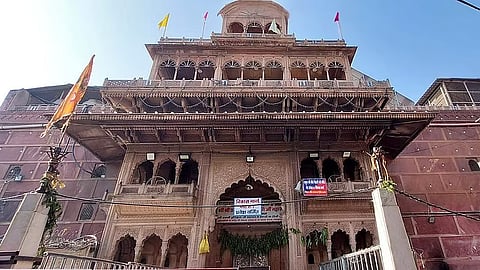

LUCKNOW: Advancing its plan for the proposed Banke Bihari Corridor in Vrindavan to manage the overwhelming crowds at the historic temple, the Uttar Pradesh government introduced the Shri Banke Bihari Temple Trust Bill on the third day of the Monsoon Session of the state Assembly on Wednesday.
The bill stipulates the formation of a temple trust with complete authority over all offerings, donations, and both movable and immovable assets of the temple. This includes the idols housed within the premises, gifts and offerings made to the deities, assets provided for worship, rituals and ceremonies, and all cash, bank drafts, and cheques received for temple use. Additionally, temple property will include jewellery, grants, contributions, hundi collections, and associated assets.
It is noteworthy that the Supreme Court of India, on Friday (8 August 2025), stayed the operation of the Banke Bihari Temple Trust Ordinance issued by the state government earlier this year. The ordinance, dated 26 May 2025, sought to place the administrative control of the temple under the newly-formed trust, pending a final decision by the High Court on its validity.
The Supreme Court’s August 8 order also proposed to amend its earlier 15 May judgement, which had permitted the UP government to use temple funds to acquire five acres of land around the temple for corridor development.
Nonetheless, the state government proceeded to table the bill in the Assembly on Wednesday at 11 am, underscoring its intent to create a trust that honours the spiritual legacy of Swami Haridas. The government assured that all religious customs, festivals, rituals, and ceremonies would continue unchanged.
The trust will be responsible for setting darshan timings, appointing priests, deciding their remuneration, ensuring the safety of devotees, and managing the day-to-day administration of the temple.
The bill outlines the objective of providing world-class amenities to devotees. Proposed facilities include:
Prasad distribution centres
A dedicated darshan path for senior citizens and persons with disabilities
Drinking water stations and resting benches
Queue and access management kiosks
Cow shelters, an Annakshetra, kitchens, hotels, inns, exhibition halls, canteens, and waiting rooms
As per the bill, the Shri Banke Bihari Temple Trust will consist of 18 members, 11 nominated and 7 ex-officio.
Nominated Members:
Three eminent representatives from Vaishnav traditions, sects, or peeths (sadhus, saints, gurus, scholars, mahants, acharyas, or swamis)
Three eminent representatives from other Sanatan Dharma traditions (same criteria as above)
Three distinguished individuals from any branch of Sanatan Dharma (such as scholars, educationists, entrepreneurs, professionals, or social workers)
Two representatives from the Goswami tradition, direct descendants of Swami Haridas Ji (one each from Raj-Bhog Sevadaars and Shayan-Bhog Sevadaars)
All nominated members must be Sanatani Hindus and will serve a term of three years.
Ex-Officio Members:
District Magistrate of Mathura
Senior Superintendent of Police, Mathura
Commissioner of the Municipal Corporation
CEO of the Uttar Pradesh Braj Teerth Kshetra Vikas Parishad
CEO of the Banke Bihari Temple Trust
One nominated representative of the state government
In the event that any ex-officio nominee is a non-Hindu or does not subscribe to Sanatan Dharma, a junior officer will be appointed in their place.
The trust is required to meet at least once every three months, with a minimum of 15 days' prior notice. Members will not be held personally liable for any decisions taken in good faith.
The trust may independently purchase movable or immovable property up to a value of ₹20 lakh. Any acquisition exceeding this limit will require government approval. The Chief Executive Officer of the trust will be an officer of ADM (Additional District Magistrate) rank.
This bill formalises the temple’s administrative framework while safeguarding its centuries-old religious traditions, offering a roadmap for improved governance and an enhanced experience for devotees.