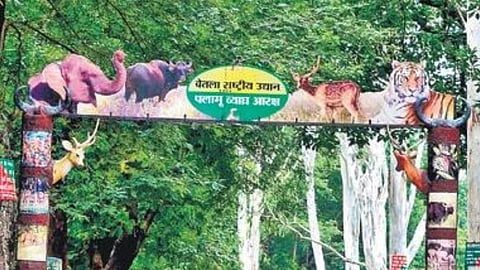

RANCHI: In a first-of-its-kind initiative in Jharkhand, villages located in Palamu Tiger Reserve (PTR) will be protected with biological fence (bio-fencing) to prevent man-elephant conflict.
PTR officials have devised an innovative approach to prevent man-animal conflict by introducing bio-fencing around the villages, under which, different layers of plant species will be planted to keep away elephants from populated areas. Bio-fencing involves planting a three-tiered arrangement of thorny and citrus species, such as sisal, lemon grass and lemon.
“First layer of sisal plant works as a natural repellant by providing a tough, thorny barrier that discourages intrusion without harming animals, while the second layer of lemon grass emits volatile oils that repel elephants by irritating their olfactory sensors. Similarly, in the third layer, the thorny branches and pungent citrus smell of lemon plant create a strong psychological and physical deterrent,” said PTR Deputy Director, Prajesh Kant Jena.
Further, bio-fencing is low-maintenance, self-regenerating, and environmentally safe, he added. Jena further added that the idea behind growing such plants is that these plants can act as a natural barrier to stop elephants from entering human settlements. The plants also offer long-term income potential through fiber, essential oils, and fruit markets, aligning conservation with rural development, he said.

Besides, these plants require low maintenance and are also economically beneficial for the villagers. The PTR Deputy Director informed that this pilot project in Betla Range is potentially the first of its kind in the state, and may serve as a replicable blueprint for other conflict-prone landscapes in Jharkhand and beyond.
“The bio-fencing is expected to significantly reduce elephant intrusions into farmlands, mitigating crop loss and human-wildlife conflict in fringe villages of the Betla Range,” said Jena, adding that the project was conceptualised not only as an eco-friendly solution to human-elephant conflict but also as a model for community-based economic empowerment. The selection of plant species was based on their dual utility.
The Eco Development Committee is responsible for planting and managing these lemon plants, which may be also be used for commercial purposes, boosting local economy.
In addition to the bio-fencing, the PTR is also introducing solar-powered lighting in elephant corridors to improve safety for both the animals and nearby communities.