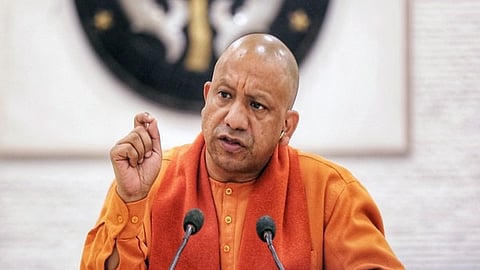

LUCKNOW: The dream and vision of good governance and a developed Uttar Pradesh can be realised only with a smooth, quick, and accessible judiciary in the state, said UP Chief Minister Yogi Adityanath while addressing the 42nd session of the Uttar Pradesh Judicial Service Association here on Saturday.
The CM described the judiciary as the protector of good governance and reiterated his government’s commitment to strengthening it. Calling the conference the “Mahakumbh of Judicial Officers”, which reflected unity, mutual cooperation, and professional excellence, CM Yogi announced a Rs 50-crore corpus fund for the Judicial Service Association, in addition to the Rs 10-crore fund created in 2018.
He welcomed judges, retired judges, and judicial officers from across the state, saying the convention symbolised the collective strength and efficiency of the judiciary.
Underscoring the fact that UP has the country’s largest High Court, with benches in Prayagraj and Lucknow, Yogi praised the 102-year-old Judicial Service Association for its contribution to social evolution and expressed confidence that judicial officers would continue to set new benchmarks of unity and efficiency.
Underlining the significance of timely and affordable justice, the CM claimed that 72 lakh cases were disposed of in district and trial courts in 2024. However, with over 1.15 crore cases still pending, he acknowledged the challenge, stressing that “the faster the pace of disposal of pending cases, the stronger would be the public confidence in the judiciary”. He assured, “The government is ready to cooperate at every level.”
Referring to the new criminal laws—the Indian Justice Code, Indian Civil Defence Code, and Indian Evidence Act—implemented from 1 July 2024, the CM praised judicial officers for their swift adaptation. He said the new framework focused on a robust justice delivery system rather than punishment and would prove a milestone in strengthening both the judiciary and democracy.
The Chief Minister detailed the government’s initiatives to strengthen the judicial system, highlighting major allocations for infrastructure and facilities.
He said the government had sanctioned extensive funds for the High Court, including Rs 62.41 crore for residences of Justices in Prayagraj, Rs 117 crore for the Lucknow Bench, and Rs 99 crore for officers and staff housing.
In-principle approval was also given for 896 residential units in Prayagraj, along with ₹112.06 crore for a commercial block and ₹44.91 crore for the preservation of the Allahabad High Court’s heritage building.
Moreover, ₹1,645 crore was sanctioned for setting up integrated court complexes in 10 districts, with work already underway in six. “These complexes will house district courts, family courts, commercial courts, and motor accident claim tribunals under one roof,” said the CM.
Reaffirming the government’s zero-tolerance policy towards crimes against women and children, the CM said that 381 POCSO and fast-track courts were established. To further strengthen judicial infrastructure, funds of ₹148 crore in 2023–24, ₹239 crore in 2024–25, and over ₹75 crore in 2025–26 were released with central support for the construction of courtrooms and residential facilities.
The CM said Uttar Pradesh had fully implemented the Second National Judicial Pay Commission, sanctioning ₹1,092.37 crore for the purpose. For judicial training and welfare, allocations included ₹54.28 crore for a 400-bed hostel, ₹14.22 crore for a sports complex, and additional funds for lecture halls, an auditorium, and administrative buildings at the Judicial Training and Research Institute in Lucknow. He added that over ₹387 crore has been sanctioned for Dr Rajendra Prasad National Law University, Prayagraj, while 110 Gram Nyayalayas were made functional across the state.
Emphasising the ongoing modernisation process, CM Yogi said work was underway on an interoperable criminal justice system integrating e-courts, e-policing, e-prisons, e-prosecution, and e-forensics. The use of data analytics and AI would help reduce pendency and accelerate the justice delivery system.
Prominent among those present on the occasion included Chief Justice of Allahabad High Court Justice Arun Bhansali, Justice Manoj Kumar Gupta, Justice Rajan Rai, Justice Rajesh Singh Chauhan, senior office-bearers of the Judicial Service Association, retired judges, and judicial officers from across the state.
