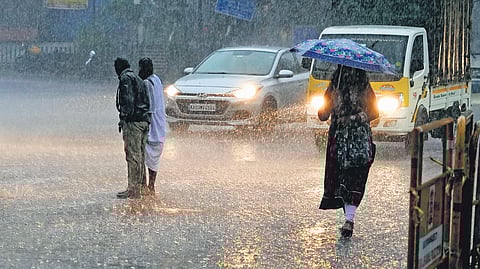

CHANDIGARH: Incessant rainfall in the catchment areas has continued to swell the Sutlej, Beas, and Ravi rivers, while the release of surplus water from the Pong, Bhakra, and Ranjit Sagar dams has further aggravated the situation. The gushing waters have inundated large tracts of farmland and villages along the three rivers, throwing normal life out of gear in Punjab and turning the situation grim.
The worst-affected districts are Gurdaspur, Tarn Taran, Kapurthala, Ferozepur, and Fazilka, where schools have been ordered to remain closed.
The swollen Ravi has become a major source of worry for residents of Gurdaspur as inflows into the river continue to rise due to heavy rains upstream.
According to official data, the water level of the Ravi at Makora Pattan in Gurdaspur touched 2.50 lakh cusecs on Monday morning, prompting the civil administration to remain on alert. At Harike, where the Beas and Sutlej rivers converge, the water level was recorded at 2.34 lakh cusecs. As this water flows downstream to Hussainiwala in Ferozepur and further into Fazilka, local authorities and residents are on high alert and prepared for emergency evacuations.
The water flowing from the Beas and Sutlej into the Harike Headworks has already ravaged thousands of acres of crops in several villages in Tarn Taran, Ferozepur, and Fazilka districts.
Schools in Jalandhar, Hoshiarpur, Pathankot, Amritsar, Gurdaspur, Fazilka, and Ferozepur districts have also been shut, while the respective district administrations have issued evacuation advisories to flood-hit villages as waters continue to rise.
Due to heavy rainfall in neighbouring Himachal Pradesh and Punjab, the Ravi and Ujh rivers, along with the Jalaliya, Chakki, and various canals and drains flowing through Pathankot district, are running beyond capacity.
In Gurdaspur, the release of water from the Ranjit Sagar dam has inundated farmland in the Dera Baba Nanak area. Several villages situated between the Ravi river and the international border, along with others, are also submerged.
Meanwhile, relief camps have been set up across several districts, with teams from health, animal husbandry, water supply and sanitation, and revenue departments actively working in the affected villages.
Cabinet minister Harbhajan Singh ETO has been tasked with reviewing flood relief work in Tarn Taran, while MLA Manjinder Singh Lalpura and Barinder Goyal will be visiting flood-affected areas of Pathankot and Gurdaspur to oversee relief and evacuation operations.
To monitor and coordinate relief measures, the state government has established a central flood control centre in Jalandhar and has roped in the National Disaster Response Force (NDRF) and State Disaster Response Force (SDRF) to assist district administrations and the police in rescue efforts.
The India Meteorological Department (IMD) has issued a red alert for Ludhiana, Sangrur, Barnala, and Mansa districts, warning that intense rainfall and thunderstorms could disrupt normal activities and damage infrastructure.