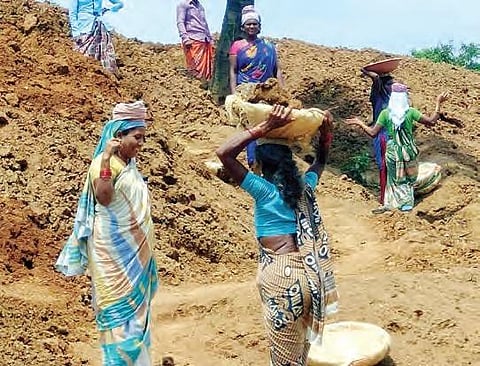

AHMEDABAD: At a time when the Centre has pushed through a bill to rename the Mahatma Gandhi National Rural Employment Guarantee Scheme (MGNREGS), official data submitted in the Lok Sabha on December 16 points to a steady erosion of the scheme’s reach in Gujarat rather than a revival.
The figures show a clear and sustained decline in employment under MGNREGS in the state, closely linked to large-scale deletions of workers from official rolls and mounting delays in wage payments. Employment in Gujarat stood at over 15.16 lakh workers in 2018–19. After a dip in 2019–20, the numbers rose sharply during the pandemic year of 2020–21 to 19.31 lakh, before entering a prolonged downward phase. By 2023–24, employment had fallen to 15.11 lakh, declined further to 13.06 lakh in 2024–25, and dropped sharply to just 9.01 lakh in 2025–26, as of December 11.
This contraction has coincided with significant churn in the MGNREGS database. In 2022–23, Gujarat deleted 5.59 lakh workers while adding only 3.20 lakh, resulting in a net loss. The following year saw an even sharper purge, with 9.75 lakh workers deleted against just 3.01 lakh additions, a trend that directly mirrored the fall in employment.
Although the state added 10.77 lakh workers in 2024–25, the rebound proved short-lived. In 2025–26 so far, additions have slowed to 1.74 lakh, deletions have continued, and overall employment levels have remained significantly lower. The data indicates a direct link between shrinking job card rolls and declining access to work, translating into fewer days of guaranteed employment under the scheme.
The government has maintained that job card verification is a continuous exercise and that renewal is mandatory every five years under MGNREGS. However, when deletions consistently outpace additions, the process appears less like routine verification and more like a structural narrowing of access to the programme.
The situation is further aggravated by pending payments. As of December 5, 2025, Gujarat had Rs 61.43 crore in unpaid wages and Rs 21.54 crore in pending material costs. These delays directly affect workers whose participation in the scheme depends on timely remuneration, weakening confidence and discouraging demand for work, thereby reinforcing the cycle of declining participation.
National data underscores the broader stress on the scheme. Across the country, pending dues under MGNREGS total Rs 9,746.39 crore, including Rs 1,340.07 crore in wages, Rs 7,863.37 crore in material payments and Rs 542.95 crore in administrative costs, against a total allocation of Rs 86,000 crore for 2025–26. While the Centre has stated that fund releases and dues fluctuate daily, the scale of arrears points to systemic pressure rather than temporary delays.
Taken together, the figures highlight a growing gap between symbolism and substance. Even as the scheme’s name is set to change, its footprint in Gujarat is contracting, with fewer workers on the rolls, fewer job cards, reduced employment and crores of rupees locked in pending payments. Without stabilising worker databases and clearing wage backlogs, the data suggests that MGNREGS risks being rebranded at the top while being hollowed out at the ground level.
