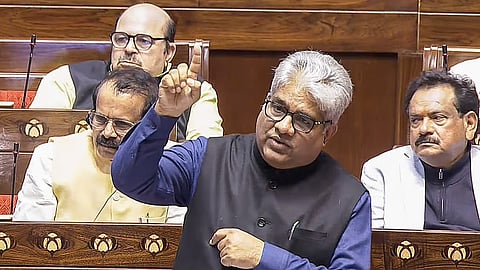

NEW DELHI: The Union Minister of Environment, Forest, and Climate Change, Bhupender Yadav, rejected reports claiming that mining is being promoted in major parts of the Aravalli Hills following a Supreme Court order.
He stated that the Supreme Court's decision will protect over 90% of the Aravalli region.
Yadav spoke to reporters at the Sundarban Tiger Reserve in West Bengal after chairing a meeting of the National Tiger Conservation Authority. He explained that the Supreme Court-approved definition of the Aravalli Hills will classify more than 90% of the area as a "protected zone."
The Union Government announced a freeze on new mining leases in the region as mandated by the Supreme Court. This freeze is part of a framework established by the court to provide stronger protections for the mountain system and to ensure that no new mining leases are granted until a comprehensive management plan is finalized.
Amidst controversy surrounding the "100-meter" criterion, the government clarified that the definition of the Aravalli hills and ranges has been standardized across states under the Supreme Court's direction.
This standardization aims to eliminate ambiguity and prevent the misuse of practices that allowed mining to occur dangerously close to the bases of the hills.
In response to longstanding cases concerning illegal mining in the Aravallis, the Supreme Court constituted a committee in May 2024 to recommend a “uniform definition” since different states had been using inconsistent criteria for granting mining permissions, according to news reports.
The committee, chaired by the Environment Ministry Secretary and composed of representatives from Rajasthan, Haryana, Gujarat, and Delhi, along with technical experts, found that only Rajasthan had an officially established definition, which it has adhered to since 2006.
According to this definition, landforms that rise 100 meters or more above local relief are classified as hills, and mining is prohibited within the lowest bounding contour that encloses such hills, regardless of the height or slope of the landforms inside the contour.
It has been agreed that all states will adopt this long-standing definition from Rajasthan, along with additional safeguards to enhance objectivity and transparency. These measures include treating hills located within 500 meters of each other as a single range, requiring the mapping of hills and ranges on Survey of India maps before making any mining decisions, and clearly identifying core and inviolate areas where mining is prohibited.
In a background note circulated to the media, the government denied claims that mining has been permitted in areas below 100 meters.
It emphasized that the restrictions apply to entire hill systems and their enclosed landforms, not merely to the hill peaks or slopes. The government reiterated that it is "incorrect to conclude" that all landforms below 100 meters are available for mining.
