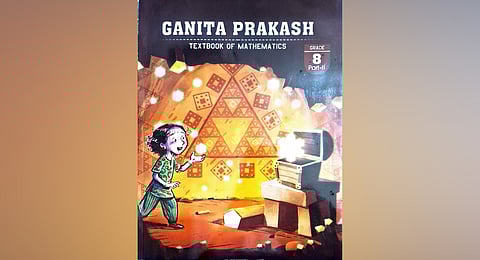

NEW DELHI: Storytelling and hands-on activities have been woven together in the second part of the revised NCERT Mathematics textbook for Class 8, which has just been completed. The book highlights contributions of Indian mathematicians throughout, aiming to create awareness among students about India’s rich mathematical heritage and global contributions.
TNIE was given exclusive access to Ganita Prakash, Textbook of Mathematics Grade 8 Part-II, framed in line with the National Education Policy 2020. “This textbook aims to be more than just a textbook, it is a passport to a world of mathematical discovery and exploration,” states Ashutosh Wazalwar, Professor and Academic Convenor, Department of Education in Science and Maths, NCERT, in his foreword.
The first part of this textbook was released in July this year. According to a senior NCERT official, the only revised book pending release for Classes I to VIII is Part-II of Social Studies for Class VIII.
In the new textbook, the concept of percentages is introduced through statements accompanied by visuals, for instance: the human body is about 60% water by weight; over 80% of teenagers globally fail to meet the recommendation of at least one hour of daily physical activity; and about 99.86% of the solar system’s mass is contained in the sun.
The role of India’s mathematical geniuses in the past is highlighted throughout. Under the chapter on fractions, catchily titled Fractions in Disguise, the book notes, “The idea of ‘per hundred’ can be found as early as the 4th century BC in Kautilya’s Arthashastra.”
Baudhāyana’s Sulba Sutra (800 BC) is explored in detail, including questions and answers it poses. The textbook emphasises that Baudhāyana’s Pythagoras theorem, one of the most fundamental theorems in geometry, expresses the relationship among the three sides of a right-angled triangle.
Proportional reasoning
The concept of proportional reasoning is explained using relatable examples, such as idli batter: “Idli batter is made by mixing rice and urad dal. The proportion of these two can vary regionally. One common ratio is: for two cups of rice, we add one cup of urad dal. We represent this relationship using the notation 2:1.”
Ratios are further elaborated with a visual example: a character named Viswanath using a mixie to prepare a spice mix while a young girl watches. “He grinds 8 spoons of coriander seeds, 4 red chilies, 2 spoons of toor dal and 1 spoon of fenugreek seeds. The ratio of coriander seeds to red chilies to toor dal to fenugreek seeds is 8:4:2:1.”
Fractals, or self-similarity in smaller copies, are explained through a fern leaf, with additional examples such as the Sierpinski Carpet, Sierpinski Gasket, and Koch Snowflake illustrated through simple, accessible examples.