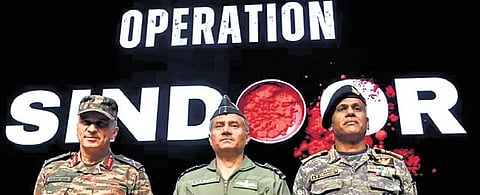

The year of defence reforms
This year will be remembered for Operation Sindoor, a decisive strike that destroyed eleven terror infrastructure targets in Pakistan and PoK, underlining India’s operational capability and the growing strength of its indigenous defence production. 2025 marked record highs in defence manufacturing, with production reaching `1.51 lakh crore, an 18% rise over the previous year.
Defence PSUs contributed 77% of output, while private players, including MSMEs and startups, accounted for 23%, supplying platforms, electronics, weapons, and subsystems. Exports surged to `23,622 crore, over 12% higher than 2024, spanning radars, torpedoes, helicopters, and missile components delivered to more than 100 countries, including the US, France, and Armenia. Policy reforms, Defence Corridors in UP and Tamil Nadu, and innovation platforms like iDEX are fostering a new era of AI-driven, innovation-led defence capabilities. Op Sindoor thus showcased India’s growing self-reliance and defence footprint.
- Mayank Singh
Eliminating left extremism on track
Despite two major terror incidents, the Pahalgam attack in Jammu & Kashmir and the Red Fort blast, 2025 marked a paradigm shift in India’s internal security management. Under Amit Shah, the Ministry of Home Affairs focused less on crisis response and more on preventive, technology-led, and development-linked strategies. Enhanced intelligence coordination, data sharing, and surveillance strengthened monitoring of cross-border threats.
Left Wing Extremism (LWE) declined significantly, with 1,850 operatives killed, over 16,000 arrested, and nearly 9,600 surrendered. Targeted development— roads, education, financial inclusion— shrank extremist spaces, making LWE a localised challenge rather than a pan-India threat. In J& K and the Northeast, reduced violence allowed focus on governance, youth engagement, and development while maintaining readiness against terror. This year was a shift from reactive security to strategic, preventive, and intelligence-driven frameworks.
- Mukesh Ranjan
In top court: justice delivered
the Supreme Court delivered several key judgements shaping India’s constitutional, judicial, and social landscape. A landmark ruling clarified that no timelines can be fixed for Governors or the President to assent to bills, while cautioning against indefinite delays. The Court partially stayed controversial provisions of the Waqf (Amendment) Act, refusing a blanket stay. It also ruled that Speakers do not enjoy constitutional immunity under Articles 122 and 212.
In education, the Court upheld that teachers in minority institutions must clear the Teachers Eligibility Test under the Right to Education Act to continue service. A five-judge bench allowed direct recruitment of District Judges from the Bar, broadening judicial entry. In a historic decision, the Court affirmed transgender rights, directing compensation for employment denial in the Jane Kaushik case. SC also struck down key provisions of the Tribunals Reforms Act, reiterating that parliament can’t revive unconstitutional measures.
- Suchitra Kalyan Mohanty
Electoral wins and major initiatives
India’s political and legislative sphere saw major achievements alongside controversies this year. The NDA could push through key initiatives, while the Opposition criticised moves they deemed deficient. SIR in Bihar sparked nationwide protests but proved electorally advantageous for the BJP. Parliament passed the Waqf (Amendment) Bill, the VB-G RAM-G employment guarantee, SHANTI nuclear reforms, and the Health Security & National Security Cess Bill. Vice President Jagdeep Dhankhar’s abrupt resignation added political intrigue. On the international stage, Operation Sindoor, Shubhanshu Shukla’s ISS mission, and the Mahakumbh captured attention, while domestic achievements included NextGen GST reforms, criminal law modernisation, and major railway infrastructure projects like the Pamban Bridge and Vande Bharat trains. In electoral politics, the BJP scored wins in Delhi, Haryana, Maharashtra, and Bihar. The party further made headlines by announcing Nitin Nabin as its working national president.
- Rajesh Kumar Thakur
Health: Cracks in care systems
The year will be remembered for India giving a mega push to strengthen and further expand its healthcare infrastructure, and taking giant strides in digital advancement and medical education, in a bid to make healthcare more accessible and affordable to its people. But the year will also be remembered for the death of over 20 children in Madhya Pradesh and Rajasthan from contaminated cough syrups – putting the spotlight on the need for stronger drug regulatory policy, and the state of India’s public health system in smaller towns and cities.
The news of at least 11 thalassemia-affected children contracting HIV after receiving blood transfusions at state-run hospitals in Madhya Pradesh and Jharkhand in November and December also exposed the systemic failure of the blood banking system in India. Amidst the gloom, was the roll out of weight loss drugs, primarily used to manage diabetes. According to a recent Lancet study, India is expected to see 450 million overweight or obese adults in 2050.
- Kavita Bajeli-Datt