
NEW DELHI: Economists have asked the government to keep the momentum going for capex even as they highlighted the need for more fiscal consolidation in a pre-budget meeting with Prime Minister Narendra Modi on Tuesday. They have even asked the government to do away with the fertilizer subsidy and instead bring direct benefit transfer, a source revealed.
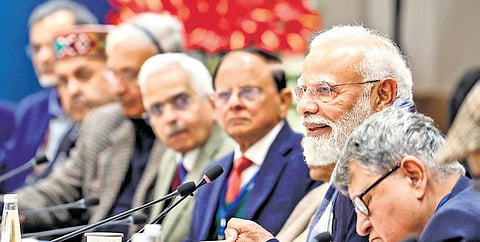
PM Modi interacted with a group of eminent economists and experts as part of the pre-budget consultation at the NITI Aayog on Monday.
“One of the suggestions include the need to keep pushing for capex further, and strive for a higher capex-to-GDP ratio,” said the source. In the FY26 Budget, the government had kept a budget of around Rs 11.11 lakh crore for capital expenditure, which translates to roughly 3.1% of GDP.
Some economists have also urged the government to take measures to make India self-reliant in critical minerals, considering what China did with the rare earth export in the recent past. Some of them also stressed on the need to diversify the service exports market for Indian service providers. They highlighted that exports are limited to a few categories of services, and so are the exports markets.
NITI Aayog in a statement said that the economists have also highlighted the need to lift productivity and competitiveness across manufacturing and services, stressing faster structural transformation. The discussion highlighted the role of higher household savings, sustained infrastructure investment and wider adoption of advanced technologies. Artificial intelligence was seen as a cross-sector productivity enabler, alongside the continued scaling up of India’s digital public infrastructure.
“While the government has taken several measures in the past to enhance the household savings, economists pointed out that there is still the need to ensure better household savings, as the household debt has been going up in India,” said the source. Economists warned that weaker domestic savings could limit the overall economic growth of the country.
The economists have suggested the government to allocate more budget for research and development across several sectors and make more investments in human capital in the coming time.
Higher household savings, infra investment in focus
NITI Aayog said that the economists have also highlighted the need to lift productivity and competitiveness across manufacturing and services, stressing faster structural transformation. The discussion highlighted the role of higher household savings, sustained infra investment and wider adoption of advanced technologies
