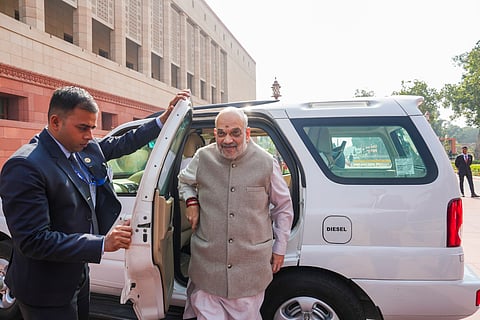

NEW DELHI: Union Home Minister Amit Shah has said that the government has worked out a plan to apply Artificial Intelligence (AI) tools to identify and close the “mule accounts” before they are made operational for laundering money generated through cyber fraud.
Announcing this at a meeting of the Parliamentary Consultative Committee for MHA on ‘Cyber Security and Cyber Crime’, the Home Minister said, “Efforts are underway to use AI tools for identifying mule accounts in coordination with the Reserve Bank of India and all banks, to establish a system for their detection to ensure that the money defrauded is not laundered.”
Shah, who chaired the meeting, also stressed raising awareness on “Stop-Think-Take Action” as propounded by Prime Minister Narendra Modi to prevent cases of cyber fraud and crime.
The Home Minister said, the government is moving forward with a four-pronged strategy to tackle cases of cybercrime, which are ‘Convergence, Coordination, Communication and Capacity’. He also asserted that the MHA’s goal “is to ensure zero cybercrime cases and their FIRs”.
The Home Minister said that inter-ministerial and inter-departmental coordination within the Ministry of Home Affairs has been strengthened, ensuring seamless communication and smooth flow of information. “A healthy tradition of exchange of information between the MHA, the Ministry of Electronics and IT, CERT-IN, I4C, and departments like Telecom and Banking has led to successfully tackling many cybercrime cases,” he said.
The meeting was attended by Union Ministers of State for Home Affairs Nityanand Rai, Bandi Sanjay Kumar, members of the Committee, Union Home Secretary Govind Mohan, and senior officials of the MHA.
The Home Minister, highlighted that the expansion of digital infrastructure has led to an increase in the number of cyberattacks. He also said that "when we look at cyberspace from a different perspective, it forms a complex network of software, services and users. We need to control them to deal with issues in cyberspace”.
Shah said, “Today, 95 per cent of villages in the country are digitally connected, and one lakh gram panchayats are equipped with Wi-Fi hotspots. In the past ten years, the number of internet users has increased by 4.5 times.” He went on to add that in 2024, a total of 246 trillion transactions worth Rs 17.221 lakh crore were made through UPI, which is 48 per cent of the total global digital transactions.
Shan further pointed out that said that the startup ecosystem in India has become the third-largest country in the world. As of 2023, the digital economy contributed around 12 per cent or Rs 32 lakh crore to the Gross Domestic Product (GDP), creating nearly 15 million jobs.
Giving details of the cases registered so far, the Home Minister said, a total of 1, 43,000 FIRs have been registered on the I4C portal, and over 19 crore people have used this portal, as for national security reasons 805 apps and 3,266 website links have been blocked based on the I4C’s recommendations.
“More to these 399 banks and financial intermediaries have come on board. Over 6 lakh suspicious data points have been shared, more than 19 lakh mule accounts have been caught, and suspicious transactions worth Rs 2,038 crore have been prevented,” Shah said, adding that Cyber Crime Forensic Training Labs have been established in 33 states and union territories.
“On the ‘CyTrain’ platform, a “Massive Open Online Course (MOOC)” platform, 101,561 police officers have registered, and over 78,000 certificates have been issued.