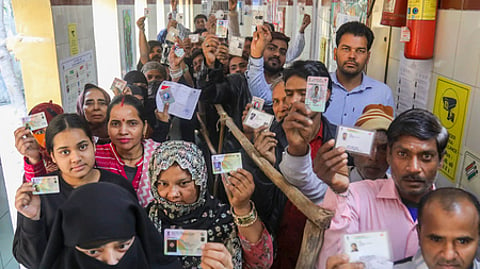

NEW DELHI: There has been a 15-fold increase in the number of political parties (from 54 in 1951-52 to 743 in 2024) contesting in general elections, and a five-fold increase in the number of contesting candidates, from 1,874 in 1951-52 to 8,360 in 2024, according to data released by the Election Commission of India (ECI) on Tuesday.
In a statement, the poll panel said, “In the first General Election of 1951, there were only 1.96 lakh polling stations, but by 2024, this number had surged to 10.53 lakh polling stations, a testament to the Commission’s relentless efforts to ensure that no voter is left behind.”
It went on to add that the electorate base has grown exponentially. In the first Lok Sabha elections, the number of electors stood at 17.32 crore, whereas, in 2024, the electorate swelled to over 97 crore.
According to the ECI data, more than 64.6 crore electors exercised their right to vote in the 2024 General Election, marking a significant increase in voter participation.
“The voter turnout in 1951-52 was just 45.7%, but by 2024, this had risen to above 66%, making it the third consecutive General Election where voter participation exceeded 65%,” the poll panel said. It also noted that the political landscape had seen remarkable growth. In 1951-52, only 53 political parties participated in the elections, while more than 740 political parties contested in 2024.
In terms of the number of candidates contesting the elections in 2024, the figure stood at an astounding 8,360, with 7,190 candidates forfeiting their deposits.
Maharashtra emerged as the state with the highest number of contesting candidates, fielding 1,121 candidates, while Ladakh and Nagaland saw the lowest, with only three candidates each. This disparity highlights the contrasting political engagement levels across regions, with densely populated states experiencing higher competition.
The ECI data also highlighted that in the 2024 elections, out of the total of 543 elected candidates, 74 were women. This marked steady progress toward gender inclusivity in Indian politics, with West Bengal leading the way by electing the highest number of female candidates, with 11 women. On the other hand, Uttar Pradesh elected the highest number of male candidates, with 73 out of 80.
In terms of female participation, Maharashtra once again led the way, with 111 female candidates contesting, followed by Uttar Pradesh (80) and Tamil Nadu (77). However, 152 constituencies across the country had no female contesting candidates at all, the data revealed.
