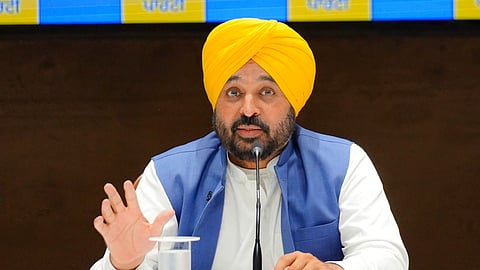

CHANDIGARH: The Aam Aadmi Party-led Punjab Government is set to introduce a fresh and more stringent bill to tackle acts of sacrilege during a special two-day assembly session scheduled for July 10 and 11. The proposed legislation includes provisions for life imprisonment or even the death penalty for individuals found guilty of desecrating any religious scripture.
This will be the third consecutive Punjab government to bring forward anti-sacrilege legislation. Previous attempts by the Shiromani Akali Dal (SAD)-BJP government in 2016 and the Congress government in 2018 were either returned by the Centre or failed to receive Presidential assent.
During a meeting held last Saturday at the Chief Minister’s official residence with representatives of the Sarb Dharam Beadbi Rokko Kanoon Morcha, Chief Minister Bhagwant Mann had announced the government’s intent to introduce the new law. Sources confirmed that a state-specific amendment to the Bharatiya Nyaya Sanhita (BNS) will be required.
“The government is currently seeking legal opinion on including the death penalty for sacrilege. If not legally viable, the bill will at least propose life imprisonment,” a senior official said.
Sources said that it is not clear whether the government will introduce this bill in the upcoming assembly session on July 10 and 11 proposing life imprisonment or even death penalty for those found guilty of desecrating any religious scripture.
After the state cabinet meeting on Monday, Finance Minister Harpal Singh Cheema said that the government is seeking opinion of Legal Remembrance and Advocate General and does not want to bring this bill in a haste. The fine details of the bill are being worked on to ensure the bill is water-tight as earlier governments had tabled similar bills or had passed such bills which were later rolled back by the Centre.
The move comes amid growing political and public pressure for tougher punishment. Gurjeet Singh Khalsa has been protesting since October last year atop a BSNL tower in Samana (Patiala), demanding the death penalty for those found guilty of sacrilege.
The first legislative effort came in 2016 when the SAD-BJP government introduced The Indian Penal Code (Punjab Amendment) Bill, 2016 and The Code of Criminal Procedure (Punjab Amendment) Bill, 2016, recommending life imprisonment for desecration of the Guru Granth Sahib. However, the Centre returned the bills, stating that the amendments must apply to all religions in keeping with the secular principles of the Constitution.
In 2018, the Captain Amarinder Singh-led Congress government passed two similar bills, expanding the scope to include the Guru Granth Sahib, Bhagavad Gita, Holy Quran, and Holy Bible, but these too failed to secure Presidential assent. The Union Government recently returned these bills, advising the state to draft fresh legislation under the framework of the new BNS.
Chief Minister Mann had met union home minister Amit Shah in 2022 seeking Presidential assent to the two Bills passed by then Congress government.
CM Mann has repeatedly asserted that the desecration of religious scriptures is a serious issue and noted that while the BNS addresses religious places, it is silent on sacred texts. He emphasised that the matter falls under the Concurrent List, giving states the authority to enact their own law.
Sections 298 and 299 of the BNS provide for lighter penalties: up to two years' imprisonment for defiling a place of worship and up to three years for deliberate acts meant to offend religious sentiments.
The political sensitivity of the issue dates back to October 2015, when an incident of sacrilege involving the Guru Granth Sahib in Bargari during the SAD-BJP regime triggered widespread outrage and had a profound impact on Punjab’s political landscape — an event from which the Akali Dal is still seen to be recovering.
While CM Mann favours capital punishment for sacrilege, some voices within the party argue that such a sentence may not stand legal scrutiny and could be seen as excessively harsh. Nonetheless, the upcoming bill signals a firm political stance on a matter that continues to stir strong emotions across the state.
