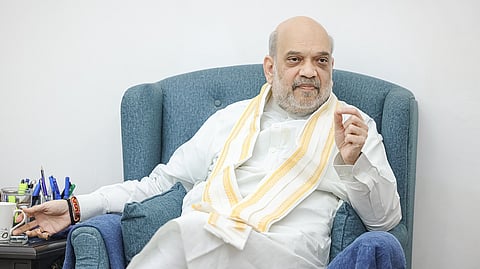

NEW DELHI: From global to national and regional, Union Home Minister Amit Shah says the Modi government has changed things for the better across the gamut.
In a freewheeling interview with TNIE Editor Santwana Bhattacharya, Chief of National Bureau Jayanth Jacob, and Senior Assistant Editor Rajesh Kumar Thakur, Shah addresses a range of issues—several directly relevant to the South. Crucially, he seeks to dispel all fears regarding funds devolution and delimitation, while being caustic on all political topics.
Excerpts:
Q: The Modi government has completed 11 years. What would you say are its three most impactful reforms?
In the decade before 2014, doubts about India’s future were common among different groups—journalists, the science community, students, farmers, business groups. The sense of uncertainty was immense. Not only within India: the entire global perception was that India had no bright future.
People often asked me what Narendra Modi faced as his biggest challenges as PM. Was it internal security, or corruption, or a broken administrative system? I believe it was the task of restoring faith in India’s future.
When we look back, I believe Modiji, as a leader and PM, along with the people of the country, worked hard to ensure the world looks up to India again. Today, 140 crore people believe India can become a fully developed nation by 2047. The world considers India the fastest-growing economy and acknowledges the role New Delhi plays as a global solution-maker. I think this is the most defining change in the last 11 years.
Sectorally too, we see great change. Critics talk only about isolated aspects. But do a comprehensive analysis—is there any area that has not seen improvement? Be it foodgrain production, advances in space, industrial growth, internal security, diplomacy, cutting corruption… If we see it as a whole, we can see the difference.
Q: On national challenges, China makes massive investments in education and health. Education is nearly free there. Millions of students enter research every year. They’re competing with the US on AI and cutting-edge tech. Is our education spend anywhere close?
The world is seeing the effects of development that has been going on in China for 50 years. We started only in 2014. Actually, Rahul Gandhi should be asked this question. What has the Congress done all these years? If it had started working with a holistic approach back then, all this work would not have piled up.
Q: Income disparities are still painfully high in India. We’re not even a fully middle-income country….
Let me give you some numbers to dispel the idea that we are caught in a low-income trap.
The health budget was around Rs 37,000 crore in 2014. Now it’s around Rs 1 lakh crore. The farm budget was about Rs 22,000 crore, it’s Rs 1.37 lakh crore today.
Infrastructure? Up from Rs 2 lakh crore to Rs 11.21 lakh crore.
Over 10 years, we have provided 60 crore poor people with housing, cooking gas, electricity, drinking water, 5 kg of free rations, free medical care up to Rs 5 lakh. That’s around 14 crore families lifted out of basic hardships, something no government could do in 75 years.
We didn’t look at things in isolation. Take our integrated approach to a sector like health. When we said we would build toilets under Swachh Bharat, people thought it was just a slogan. But it was directly linked to health. Then Nal Se Jal. No one realises that addresses the problem of fluoride-contaminated water for every household.
We brought a scheme for affordable medicines. Whether cancer, blood pressure or diabetes, medicines are now available at 20 per cent of their original cost. We made vaccinations for kids free. We’ve redesigned the malnutrition programme. From anganwadi to Class 9, the child is tracked and supported. We stopped 13 crore firewood-based cooking systems to improve women’s health.
For years, only slogans were raised based on ideology. But what did they do? Just got articles published in English?
Q: Why are we still fighting over language and medium of education?
There’s no fight as far as we are concerned. We have a firm policy: India should be run in Indian languages. The fight is in the minds of those who still believe the country should run on foreign languages. You just gave the example of China. Learn from them. Learn from Russia. Japan too. Germany as well. And France.
We respect all Indian languages. We believe the South should be run in its own languages. Two states should run in Telugu. Tamil Nadu should function in Tamil. Kerala should function in Malayalam. Hindi’s standing is not the same there.
Q: What about Hindi?
Our leaning is towards all Indian languages. We conducted CAPF constable GD exam in 13 languages. JEE, NEET, UGC are conducted in 12 languages. NEP provides for imparting primary, technical and medical education in regional languages. Stalin should tell people in TN what he has done.
Q: The two Thackeray cousins have come together on language.
That’s not the only reason. Both have come under two digits, that’s the real issue.
Q: You are tying up with the AIADMK in Tamil Nadu. How’s the language issue going there?
When I say Indian languages, Tamil is included. I have this to say to Stalin. Teach medicine in Tamil. Why don’t you? Teach engineering in Tamil. Why don’t you do it? If Tamil Nadu’s stand is that it opposes teaching in Tamil, then I have a problem.
Q: What do you feel about the AIADMK-BJP’s prospects?
We will win by a landslide.
Q: Your political acumen and strategy… does it depend on that or on what happens on the ground?
I am talking about the mood of the population. The people of Tamil Nadu are fed up with corruption, deteriorating law and order, nepotism and family feuds.
Q: If you win, will you join the government?
Yes.
Q: Is there a possibility that Vijay will join you, or PMK and smaller parties? Otherwise, it will be a multi-cornered contest.
We can’t say that now. We will make efforts to bring parties on to a single platform.
Q: What’s the biggest issue in Tamil Nadu?
Rampant corruption under the DMK. It’s a very long list—amounting to thousands of crores.
The liquor scam worth Rs 39,775 crore involved irregularities in FL2 licences, bar tenders, overcharging, illegal sales, and bottle procurement fraud.
The sand mining scam of Rs 5,800 crore: 105 hectares were exploited instead of the permitted 4.9 hectares, a 30-fold over-extraction.
In the energy scam, Rs 4,400 crore was misused through contracts awarded by DMK.
The ELCOT scam involved Rs 3,000 crore where public company shares were transferred to a private firm.
The transport department scam of Rs 2,000 crore revolved around fake tape fitment certificates.
The Rs 600-crore TNMSC scam involved contracts given through fake letterheads, companies, addresses.
Rs 450 crore was misused by procuring women’s nutrition kits at 4–5 times the actual price, favouring a private company.
The free dhoti scam of Rs 60 crore involved irregularities during Pongal.
The cash-for-jobs scam saw lakhs taken from individuals.
In the MGNREGA scam, Rs 41,503 was misappropriated per beneficiary.
Then there's the groupism in that party. The power centre is outside the state secretariat. The DMK cadre is also confused about whether to follow Sabareesan or the son or Kanimozhi or someone else. That's why DMK is trying to create issues out of nothing.
Q: But how do you address the concerns the South is raising, particularly TN—say, about fund allocation following tax devolution changes under GST and the 15th Finance Commission?
These are white lies the INDIA bloc has manufactured in order to cover up its mishandling of funds. The Modi government follows a holistic model of development, not a lopsided one. Funds to the South have increased substantially, contrary to the charges. The total allotment to the five states under tax devolution during the Modi government has gone up to Rs 10,96,754 crore from Rs 3,55,466 crore, a 209 per cent increase.
Grants-in-aid now stand at Rs 9,38,518 crore—it was Rs 2,18,053 crore during the UPA. That’s a 330 per cent rise. Tamil Nadu saw a 207 per cent growth in tax devolution—from Rs 94,977 crore to Rs 2.92 lakh crore. And grants-in-aid increased by 342 per cent—from Rs 57,924 crore to Rs 2.55 lakh crore.
Q: And delimitation? The fears are real.
I have said categorically that we are going to address any concerns the southern states may have. There will be no injustice. The Delimitation Commission Act is yet to come. Then why are they talking about it? It is because elections are coming in Tamil Nadu. It’s political. Before becoming an Act, discussions will happen in Parliament.
Q: Can the BJP sustain its momentum from Haryana and Maharashtra through upcoming elections in Bihar, Tamil Nadu, Kerala, West Bengal?
We have good prospects everywhere. We’ll repeat our win in Assam as well. I haven’t visited Bengal recently, but there’s a lot of anti-incumbency against Mamata ji. We are the only party well placed to inherit its benefits. We went up from just three seats to 77. Anyone who understands mathematics can see the trend.
The Left, after ruling for 34 years, has been reduced to zero. The Congress, which governed for 30 years, also has a zero.
Q: What about Bihar?
We feel good about Bihar. There’s no major problem. The NDA will win for sure.
Q: The Special Intensive Revision is being carried out too close to the election. There are a large number of vulnerable voters who don’t have documents. Even EBC voters. Some of your own leaders are concerned, so are your allies.
I believe that if anyone has any concerns about the process, he/she should approach the Election Commission. Not with presumptions, but with examples of the outcomes of the process. Roll revision is not happening for the first time. It happened in 1991 too. Also, it’s not being done only in Bihar. I think it will be done across India. Anyway, the matter is before the Supreme Court.
Q: The Opposition is calling it a shadow CAA-NRC.
They oppose everything the EC does. They need to justify their poll defeats, so they present fake narratives, like saying “we lost because of EVMs.”
They seem to have no problem with the same EVMs in Tamil Nadu. They take oath after the same EVM gives them victory. They take oath in Telangana. However, in Maharashtra, they say EVM is faulty.
Q: Mamata Banerjee alleges Assam CM Himanta Biswa Sarma is targeting Bengalis, especially Bengali Rajbanshis, with roll revision.
Do you not know Mamata Banerjee? Once, during a routine military exercise, she claimed the Centre had sent troops to her secretariat. How can you take what she says seriously?
Q: You have a new state president in Kerala. What do you foresee there?
It will definitely make a difference. He will bring fresh energy. I will be going to Kerala soon.
Q: When will the BJP national president’s election be held? It’s been delayed quite a bit.
It will happen very soon. Nothing has been decided yet, no names have been considered, but it will be finalised very soon.
Q: Are there differences between RSS and BJP?
No. These are imaginary stories of journalists.
Q: They say your government started caste census under pressure.
Does that deserve a serious response? If the government does what the people demand, can you deny it credit?
Q: Will it be a socio-economic survey or strictly a caste survey?
It will be a census that includes questions about caste.
Q: So, a socio-economic caste census?
No, a caste census. Socio-economic questions are a separate part of the general census.
Q: The Opposition talks about the Telangana model.
What they are doing in Telangana is a survey. We are doing a census. There is a difference. In Karnataka, they tried, but had to scrap it.
Q: The Bharatiya Nyaya Sanhita (BNS) has been implemented. How do you see its effect?
The three new criminal laws are the biggest legal reforms in independent India. You can see qualitative and quantitative changes in the justice delivery process. Once these laws are fully in force, every victim will get justice within three years up to the Supreme Court.
Q: You have said Naxalism would be eliminated by 2026. What strategies did you adopt?
I believe the Naxal movement will be nearly eliminated before 2026.
We abandoned the defensive strategy of previous governments. We filled the security vacuum in core Naxal areas while pushing forward development. We disrupted their supply chains, cut off access to funds, food, medicines, weapons, while presenting a well-structured surrender policy alongside. As a result, violent incidents of Naxalism have come down by 52 per cent—from 16,463 in 2004–14 to 7,856. Deaths have come down for security forces by 71 per cent, and for civilians by 68 per cent.
Q: What about Manipur?
There is no violence in Manipur at the moment, but the trust between the two communities has been deeply broken. Many NGOs, the government, and RSS are playing the role of a bridge between them.
Q: On another front, cybercrime is rising dangerously.
Modi ji’s vision is to build a cybersecure Bharat. Our agencies have developed an application to identify mule accounts instantly. They have been equipped with and trained in every new technology to stay ahead of cybercriminals. We launched helpline no. 1930. It handles over 60,000 calls a day. So far, over Rs 4,725 crore has been returned to nearly 14.5 lakh victims. Our Cyber Crime Portal has registered over 65 lakh unique complaints and helped file 1.5 lakh FIRs.
Q: India has seen significant drug seizures of late. Are there any targeted plans to fully eliminate drug trafficking in states like Punjab?
We have adopted a whole-of-government approach to eliminate the scourge not only from Punjab, but from the entire nation. In 2019, the MHA introduced a four-tier mechanism. Between 2004 and 2014, only 25 lakh kilograms of drugs worth Rs 40,000 crore were seized.
Between 2014 and 2025, over 1 crore kg valued at Rs 1,50,000 crore was confiscated. As many as 41 illegal synthetic drug labs have been dismantled. Crimes of all sorts have now become borderless. As much as 60–70% of drugs are carried through maritime routes. We have created a dedicated task force to counter trafficking via sea routes.
Q: Is Operation Sindoor on pause or is it a ceasefire?
The prime minister has said Operation Sindoor is ongoing.
Q: Has it lowered the threshold for military action?
No. They attacked innocent tourists. We punished the perpetrators by attacking terrorists. Pakistan considered that as an attack on itself. Their army officials attended the funerals. We had not fired even a single bullet at the Pakistan army or civilians. But they retaliated, and we attacked their air defence system. Then they said let’s stop. We agreed.
Q: What if there’s another terror attack?
Decisions will be taken as per the gravity and sensitivity of the situation. During our time, three major incidents occurred—in Uri, Pulwama, and Pahalgam. We responded befittingly.
Q: Did the international response meet your expectations? Or was it a little muted?
We cannot work assuming what the international community would think. When our people or our borders are attacked, we have the right to self-defence. Every country does. Pakistan got exposed on the world stage.
Q: How much concern is there about the Trump tariffs and their impact?
We have made it very clear that no discussion will take place at the cost of India’s interests. If anything disturbs India’s interests, it won’t be entertained.
Q: You just laid the foundation stone for a Cooperative University. What’s the idea behind it?
The cooperative sector is not symmetrical. In some states, it functions very well. In others, it has almost collapsed. When Modi ji established the Ministry of Cooperation, we studied the reasons behind the imbalance. We found several factors: outdated laws, corruption, no reform, no elections on time. So we created a strong legal framework, which most states have now adopted. Then we built a national database, identified the vacuums, and are working to fill those.
However, we also noticed a third critical gap—a lack of knowledge about cooperatives among professionals. An accountant working in a cooperative society or bank may know accounting, not the ethos or working of cooperatives. Similarly, a dairy engineer knows engineering but lacks this knowledge. The university will formalise that knowledge base.
