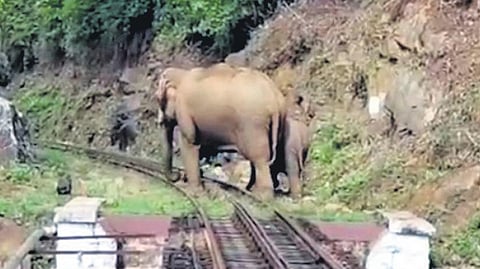

RANCHI: The death of three wild elephants, struck by a speeding Janshatabdi Express near Bastola railway station in West Bengal close to the Jharkhand border, has sparked a blame game between the Indian Railways and the Forest Department.
A herd of seven elephants was crossing the track when the train on the Kharagpur-Tatanagar railway section early in the morning on Saturday, rammed the three elephants, killing them on the spot, while four others got stuck near the ones who died. The elephants supposedly came from the Jhargram forest in West Bengal's Kharagpur.
The collision occurred on the busy Kharagpur-Tatanagar section, a corridor often used by wild elephants migrating across forested landscapes in Bengal and neighbouring Jharkhand. This incident is not a one-off, as several cases have been reported from many states where elephants died while crossing railway tracks.
Though, Railways is deeply concerned about this tragic loss of wildlife and expresses its sincere sympathy, it refused to take any responsibility for the incident.
“We have noted with concern certain statements made by the Forest Department alleging that prior information about elephant movement in the area had been communicated to the Railways, but not acted upon. The above version is not factually correct and misleading. No official communication was given by Forest Authorities either in writing or telephonically to the concerned railway authorities about the movement of elephant herds,” stated an official communique from the Indian Railways.
There is a general WhatsApp group in which one message was posted at late night, at 10.56 PM, about the movement of elephants, but it is not expected to read each and every message of a general WhatsApp group by all the members of the group in real time basis and that also near midnight, it added.
The statement further added that, since the matter was of such a grave nature, the concerned forest officials should have ensured confirmed communication with railway in writing or telephonically instead of merely posting a message in a general WhatsApp group without any follow up action.
“Due to laxity in proper communication on the part of forest officials, this unfortunate incident took place resulting in loss of precious wild lives and further created disturbance to train operations for more than 5 hours on Howrah-Mumbai main line,” stated the official communique, further adding, “We remain committed to ensuring the safety of wildlife and work in close coordination with the Forest Department to strengthen mitigation measures further.”
The Indian Railways further ensured that steps are being initiated to review and enhance protective measures in light of this incident. The reaction came from Railways after a senior official from the forest department squarely blamed the railways for the incident involving casualties of three elephants, calling it a result of “complete carelessness” on the part of railway authorities.
According to a forest department official, the railways were alerted around 11 pm on Thursday about a herd of elephants spotted near the tracks. “Despite the warning, train speed was not reduced,” the official said, alleging negligence in following safety protocols.
The department further claims that similar warnings have been issued repeatedly during previous coordination meetings, but no concrete action has been taken by railway authorities.
Notably, the Dalma-Kharagpur-Tatanagar belt has witnessed multiple fatalities in the past. In August 2018, two adult elephants and a calf were fatally struck by the Gyaneswari Express while crossing tracks near Gidhni station, roughly 180 kilometers from Kolkata.
