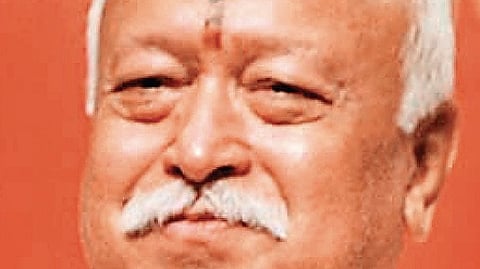

Mark your calendars — and perhaps, your diplomatic protocols. If things go as planned, New Delhi’s diplomatic circuit may find itself sitting front row at an event hosted not by the Ministry of External Affairs, but by the Rashtriya Swayamsevak Sangh (RSS). In what could be a first, officials from various embassies (with the predictable exception of our western neighbour, Pakistan) are being invited to a three-day lecture series by the RSS. The occasion? The Sangh is gearing up to celebrate 100 years of its existence, and it’s kicking things off with lecture marathons in Delhi, Mumbai, Kolkata, and Bengaluru.
The Delhi edition will open the series at Vigyan Bhawan on August 26, with Mohan Bhagwat, the RSS Sarsanghchalak himself, delivering the inaugural address. “We’re reaching out to various embassies to join us in this lecture series and hope they respond positively,” said a senior RSS functionary, sounding both hopeful and diplomatic.
The idea, it seems, is to bring together diplomats, scholars, and the capital’s who’s who to talk about “key issues concerning Bharat” — and perhaps to showcase the Sangh’s intellectual side. And no, this isn’t just another round of speeches and samosas. There’s a clear message brewing: “The Sangh’s chief lecture will give us a new direction which we are following for a powerful and viksit Bharat,” said the functionary, firmly, and the RSS is aiming for soft power points.
Poll plunge for IAS close to Nitish
With ‘double engine’ governments at the Centre and in Bihar, it hardly took a month to approve the VRS application of 2010 batch IAS officer Dinesh Kumar Rai. He is considered a close confidant of Bihar CM Nitish Kumar, and the grapevine in Delhi and Patna suggests that he will contest the upcoming assembly polls on the ruling JD(U) ticket from a constituency in Sahabad district. Incidentally, Rai was scheduled to superannuate from the service in January 2026,but he applied for the VRS on June 13, 2025, and the Union government through the Department of Personnel & Training obliged him with effect from July 15, 2025. At the time of leaving the job, Rai, a Bihar Administrative Service officer promoted to IAS, was serving as Secretary, Revenue and Land Reforms. Earlier, he was also in the CMO.
Fighting radicalisation in prisons
The Modi government has flagged growing radicalisation in prisons as a serious concern and has asked states and UTs to counter it effectively. In a circular, the Ministry of Home Affairs (MHA) urged prison authorities to develop standardised screening tools to assess inmates’ behaviour, associations, and ideological leanings at the time of admission. States have been advised to work closely with law enforcement and intelligence agencies to identify inmates who may pose a radical influence on others. The MHA also recommended setting up independent high-security prison complexes to house hardened and radicalised offenders, including terrorists.
Seeking ASI help for Agra Metro
Facing tepid ridership on the newly launched Agra Metro, the Uttar Pradesh Metro Rail Corporation (UPMRC) has sought help from the Archaeological Survey of India (ASI) to boost visibility and attract more commuters, particularly tourists. Despite its first corridor partially connecting major landmarks like the Taj Mahal, Agra Fort, Sikandara, and Mankameshwar Temple, the metro is struggling to draw riders. UPMRC cited low public awareness and limited access to route and service information as key reasons behind the underwhelming response. To fix this, it has requested ASI’s support in displaying promotional videos and pamphlets at protected monuments and on the ASI’s official website. The aim is to inform both tourists and locals about the metro’s connectivity, timings, and convenience.
A slice of civility for the civil service
Well, here’s a refreshing memo from the top: bureaucrats must meet real people. Yes, the corridors of power may soon echo with the unfamiliar sound of citizens walking in — not for selfies or ceremonial cups of tea, but for honest-to-goodness conversations about problems, policies, and the odd grievance. This directive comes straight from Cabinet Secretary T.V. Somanathan, who seems to have had enough of the “closed-door” culture that has crept into the senior bureaucracy. There’s a “perceived reluctance” among many senior officials to meet anyone outside their echo chamber of government colleagues. The keyword here is ‘perceived’, but one suspects that perception and reality may not be far apart. In a letter now circulating in babudom, Somanathan reminds secretaries of all ministries that meeting members of the public is not optional — and, importantly, should take place within official premises, not in clubs, hotels, or over a quiet drink at the gymkhana. (Yes, someone had to spell that out.) “Such interactions can offer valuable insights into ground realities, help clarify miscommunications, and even lead to better ideas,” he gently noted. One can imagine several startled secretaries mentally clearing an hour of their packed schedules. To be fair, the letter acknowledges that senior officers are pressed for time, but argues that even limited engagement with the public can go a long way in bridging gaps between policy and perception. If needed, another official can sit in on the meeting — just in case things get too real.
