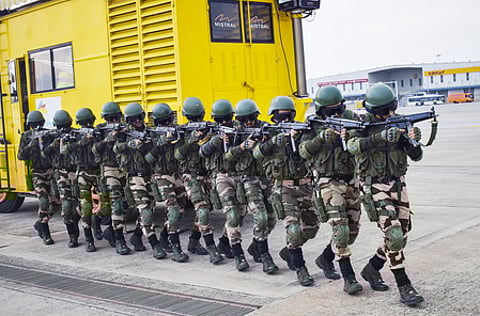

CHANDIGARH: For the first time, Central Industrial Security Force (CISF) personnel are undergoing full-scale, intensive specialised training exercises on night operations, jungle warfare, close-combat tactics, and endurance-building drills with elite Indian Army formations in the Kashmir Valley.
The move is a major step toward making the force “battle-ready” against unconventional and hybrid threats and enhancing its operational preparedness amid evolving security challenges.
Sharing information in this regard, Lalit Pawar, unit commander of the CISF Unit deployed at the Punjab and Haryana Civil Secretariat, said that CISF’s battle-hardiness refers to preparing its personnel to swiftly and effectively respond to crises at high-value and high-risk installations, such as airports, nuclear facilities, government buildings, and Parliament.
“The emphasis is on handling complex, high-pressure scenarios such as drone incursions, coordinated terrorist attacks, insider threats, and sabotage operations with speed, precision and calm,” he said.
Pawar stated that for the first time, the CISF is conducting full-scale batches of training at elite Indian Army formations in the Kashmir Valley. Previously, only a limited number of CISF personnel were allotted seats for such exercises.
“Now, following close coordination between the CISF and the Army and in recognition of the critical national interest, the Army has agreed to provide comprehensive training modules to larger contingents,” he said. These modules include night operations, jungle warfare, close-combat tactics and endurance-building drills.
He explained that the modules are designed to build on CISF’s already robust experience in urban counter-threat operations, while enhancing its ability to operate in complex terrains and high-threat zones. The goal, he said, is to equip personnel to professionally handle contingencies such as armed infiltration, sabotage, and multi-pronged terror strikes in both urban and rural environments.
He further shared that the personnel selected for this high-intensity training are part of CISF’s Quick Reaction Teams (QRTs)—the first responders to emergencies across all 369 units of the force. Only those under 35 years of age and who have passed the Battle Physical Efficiency Test (BPET), aligned with National Security Guard (NSG) standards, were eligible. “Notably, these QRT members have already completed a rigorous six-month in-house CISF training prior to joining the Army module,” he added.
Pawar said the CISF plans to expand this form of advanced combat training to more units, beginning with the most sensitive and high-risk locations.
The aim is to gradually bring all CISF personnel to a higher threshold of physical endurance, tactical proficiency and psychological resilience, ensuring the force is always prepared to protect the nation’s critical infrastructure from emerging threats.
