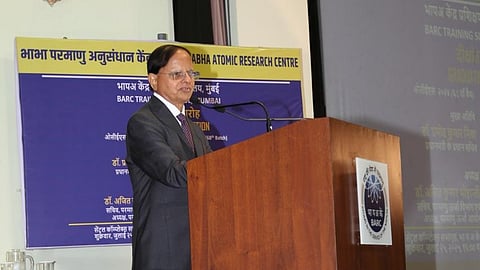

NEW DELHI: Dr PK Mishra, Principal Secretary to Prime Minister Narendra Modi, said that India’s rising geopolitical influence, strategic partnerships, global diaspora, and soft power are key factors which amplify its international presence.
Addressing the graduating Scientific Officers today at the 68th Graduation Function in the Bhabha Atomic Research Centre (BARC) Training School, marking a milestone for the institution and the next generation of India’s scientific community, Dr Mishra outlined India’s advancements in every field.
He remarked on the legacy of BARC and the vision of Dr Homi Jehangir Bhabha, praising the institution for its training excellence and contributions to India’s development. He highlighted India’s global rise driven by internal transformation and shifting international dynamics, noting strengths such as youth demographics, infrastructure expansion, and technological achievements.
Highlighting the Prime Minister’s vision for Vikshit Bharat in 2047, he underscored the importance of ‘reform, perform, and transform’ in transforming the country into a developed nation. Dr Mishra cited multiple national achievements such as India’s position as the third-largest startup ecosystem with over 100 unicorns. He also added that the scale of digital infrastructure, including UPI processing over 185 billion transactions in 2024–25 and bold climate commitments including 500 GW non-fossil fuel capacity by 2030 and initiatives like the National Green Hydrogen Mission, have helped the country move forward.
Noting the successful opening of the space sector, Mishra remarked that similar initiatives are envisaged for atomic energy, essential for clean energy and national security. He also highlighted key budget announcements from the Budget 2024–25 like R&D support for Bharat Small Modular Reactors and advanced nuclear technologies and a targeted expansion to 100 GW of nuclear capacity by 2047, with proposed amendments to relevant legislation enabling private sector participation.
Underscoring the societal impact of nuclear energy, Mishra cited the use of radio isotopes for cancer care, and radiation technologies for wastewater treatment and agricultural storage. Highlighting recent budgetary provisions aimed at boosting food irradiation infrastructure, he remarked on the sanctioning of 50 Multi-Product Food Irradiation Units for the MSME sector under the 2024–25 Union Budget and the success of projects under the Pradhan Mantri Kisan Sampada Yojana.
He noted that since 2008, 16 projects have been sanctioned, with 9 operational, alongside 19 functional facilities since 2000. The Atomic Energy Regulatory Board continues to provide vital technical support. He emphasised that irradiation facilities in 12 states are enhancing shelf-life and ensuring compliance with international phytosanitary standards for food products such as fruits, spices, pulses, and herbs.
Dr Mishra urged the scientific community to commercialise spin-off technologies emerging from research labs. He noted that the post-COVID world has undergone fundamental changes, with ongoing global conflicts reshaping geopolitical alignments and economic stability.
Underlining India’s independent nuclear journey and its recognition across scientific and diplomatic circles, the Principal Secretary cited key milestones such as the agreement with the United States, the NSG waiver, and participation in ITER, underlining India’s stature in global nuclear cooperation. He emphasised that nuclear energy presents a major opportunity for sustainable growth and clean power in response to climate challenges.
Acknowledging the capital-intensive nature of nuclear energy projects, Dr Mishra remarked that timely completion, access to low-cost finance, and leveraging private sector capabilities are key to lowering tariffs and improving feasibility. He encouraged researchers to innovate in cost reduction strategies to make nuclear energy India’s preferred power source.
He also underscored the importance of strengthening safety governance, citing the roles of the Atomic Energy Regulatory Board and the BARC Safety Council. He called for revisiting regulatory mechanisms and investing in further safety-related research, especially as private sector participation expands. He emphasised that public confidence in safety standards must be a top priority.
He urged the graduates to embrace lifelong learning, adapt to change, and foster openness, respect, and humility in collaborative environments. He remarked that technical proficiency must be matched by attitude and approach, especially in interactions with stakeholders. He also encouraged the new Scientific Officers to rise to the moment, embrace opportunity, and equip themselves to navigate both challenges and transformations ahead.
