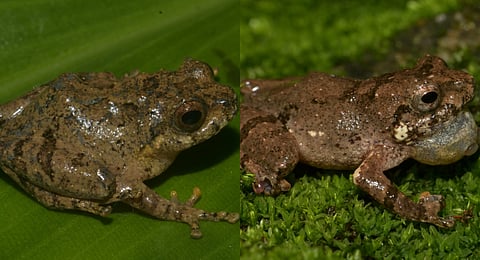

Guwahati: bridge both the sentences - Two new species of bush frogs have been discovered in the Khasi Hills of Meghalaya.
The discovered species were named ‘Raorchestes jakoid’ and ‘Raorchestes jadoh’ as a tribute to the Khasi way of life. The term ‘jakoid’ means ‘frog’ in the Khasi language, while ‘jadoh’ is a traditional rice and meat dish widely loved in Khasi households.
The naming was a way of celebrating Khasi culture and drawing attention to the close links between indigenous communities and biodiversity.
Raorchestes jakoid was discovered in Lawbah, while Raorchestes jadoh was found in Langtor. These frogs were located in bushes and trees near human settlements, indicating a degree of ecological adaptability, although their habitats remain vulnerable to rapid landscape changes.
A study on the discovery was published in the Journal of Threatened Taxa. Lead author Holiness Warjri, a native of Langtor village, shared an emotional connection with the discovery.
“Discovering a new species in my own village of Langtor is both humbling and inspiring. Naming it ‘jadoh’—a dish that brings our Khasi families together - was my way of honouring the deep bond between our culture, land, and nature. I hope this frog becomes a symbol of pride and conservation for our people,” Warjri said.
The study was conducted by researchers from the Assam Don Bosco University, Help Earth, and Mizoram University. It combined traditional field methods with advanced genetic and acoustic analyses to confirm the species as new to science.
The frogs’ unique calls, morphology, and DNA sequences place them within the Raorchestes parvulus species complex.
According to the researchers, the findings underscore the rich yet underexplored amphibian diversity of Meghalaya, a state located within the Indo-Burma biodiversity hotspot. The authors highlighted the urgent need for further herpetofaunal surveys and habitat protection in the region.
This discovery is being seen not just as a scientific milestone but also as a celebration of language, landscape, and role of local communities in conservation.
