
LUCKNOW: Coming clear on its decision over the merger of the government primary schools, the Uttar Pradesh government, on Thursday, announced that institutions with 50 or more students would not be merged.
The state government also said that any school located more than a kilometre from the next school would not be paired. It further clarified that there would be no reduction in the number of teachers’ posts.
Earlier this month, the Uttar Pradesh government had announced plans to merge (or pair) nearly 10,000 primary and upper primary schools, triggering strong protests from political parties, teachers, parents, students, and even a legal challenge.
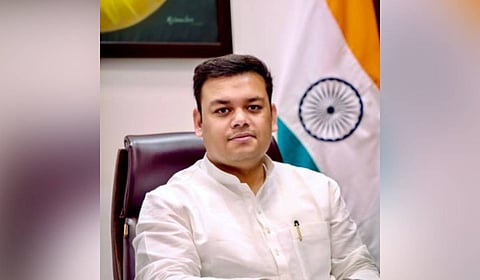
UP Basic Education Minister Sandeep Singh, speaking to media on Thursday, said that schools which did not meet the specified criteria and had been merged would be reinstated in their original positions.
He added that the now-vacant school campuses would be used to establish Bal Vatikas with the support of the Child Welfare Department. These centres aim to prepare children aged 3 to 6 years for formal schooling, functioning similarly to playgroups.
The minister emphasised that the ongoing school pairing initiative is intended to improve the quality of education without closing schools or reducing staff.
Highlighting that student welfare was the government’s priority, Singh said complaints from certain districts were taken seriously and that necessary steps had been taken to restore operations in specific schools where needed. He also stressed that the distance between paired schools would not exceed one kilometre.
The minister clarified that no school would be permanently paired. If enrolment numbers rise or seating becomes insufficient, classes would resume in the original buildings, with their UDISE codes remaining unchanged. He also stated that efforts are underway to ensure no school remains vacant by August 15 and that Bal Vatikas and pre-primary classes become operational in all schools by then.
The minister described the pairing initiative as a concrete step towards providing a better learning environment and improved access to educational resources for students.
“Through pairing, the presence of a teacher in every class will be ensured. This will improve the student-teacher ratio and give teachers the opportunity to apply modern teaching methods. As a result, teaching quality will be enhanced, and children will gain confidence and actively participate in learning,” Singh said.
He added that schools with higher enrolment will be prioritised for infrastructure and academic facilities such as smart classrooms, ICT labs, additional rooms, composite grants, teaching-learning materials, and sports equipment. “These resources will enrich students' academic experiences with technology and infrastructure,” he noted.
Regarding vacant buildings, Singh said they would be put to creative use, including running Bal Vatikas and anganwadi centres to strengthen pre-primary education. Health and nutrition-related activities would also be integrated through interdepartmental coordination.
He assured that children's access to paired schools would be made simple, safe, and convenient. Schools located in difficult terrains—across rivers, railway crossings, or highways—have been excluded from the pairing process. Any discrepancies arising during implementation are being addressed promptly.
The minister also clarified that the roles of teachers and cooks would not be affected during the process and that no posts were being removed. “In fact, the scheme mandates that schools with up to 50 enrolled students must have three appointed teachers. Schools with more than 50 students will be staffed according to set standards,” he said.
To ensure safety, an audit is being carried out for all school buildings. Dilapidated buildings are being identified and demolished where necessary. Schools are being equipped with child-friendly furniture, sports materials, learning corners, wall decorations, wonder boxes, and other teaching aids.
Singh also highlighted that over 1.26 lakh teachers had been appointed under the present government and that basic facilities in 96% of government schools had been upgraded under Operation Kayakalp. “These improvements have also been recognised by NITI Aayog as a model worth emulating,” he added.