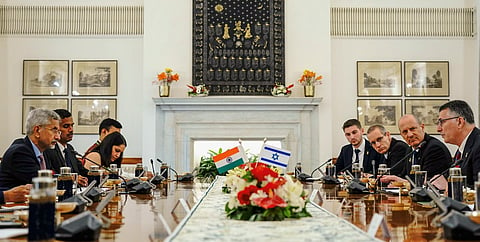

NEW DELHI: India and Israel have decided to intensify cooperation in counter-terrorism, trade, infrastructure, and regional connectivity following talks between External Affairs Minister S Jaishankar and his Israeli counterpart Gideon Sa’ar, who is on his first official visit to India.
The discussions highlighted shared commitment to a “zero-tolerance” approach toward terrorism, with Jaishankar emphasising that the two countries face “a particular challenge” from the menace.
“It is essential that we work towards ensuring a global approach of zero tolerance towards terrorism, in all forms and manifestations,” Jaishankar said during his opening remarks.
Sa’ar echoed these sentiments, describing “radical terror” as a common threat. He reiterated Israel’s condemnation of the April terror attack in Pahalgam and detailed the ongoing fight against Hamas, Hezbollah, and the Houthis, labelling them as “radical terror states.”
Stressing the need to uproot such forces, Sa’ar said: “The eradication of Hamas’ terrorist state is at the heart of President Trump’s plan. Hamas must be disarmed, Gaza must be demilitarised. We will not compromise on it.”
The evolving situation in Gaza and the recently revived US-brokered peace plan featured prominently in the talks. Jaishankar spoke about India’s support for the peace process, saying New Delhi hopes it will “pave the way for a durable and lasting solution.”
He also welcomed the release of hostages and the return of remains of those killed in the conflict.
The meeting come against the backdrop of the first phase of the US-backed 20-point peace plan between Israel and Hamas, which led to a ceasefire in Gaza and the release of captives on both sides.
The truce ended months of bloodshed following Hamas’s October 2023 attacks that killed 1,200 Israelis. Israeli offensives since then have resulted in the deaths of more than 67,000 Palestinians, including 20,000 children, according to international estimates.
Sa’ar, who is the fifth Israeli minister to visit India this year, highlighted Prime Minister Narendra Modi’s early show of solidarity with Israel after the October 7 attacks.
“We remember he was the first world leader to call Prime Minister Netanyahu after Hamas’ massacre, and we won’t forget it,” he said.
Beyond security issues, both sides discussed deepening collaboration under the India-Middle East-Europe Economic Corridor (IMEC) and expanding economic engagement. Sectors such as trade, technology, innovation, and mobility of professionals were on the agenda.
Jaishankar noted that Indian workers at present are in growing numbers in Israel, estimated at around 40,000, mainly in caregiving and construction. “They have some issues which need attention, and I hope we can take that dimension of our ties forward,” he said.
The talks also built on earlier economic cooperation, including a bilateral investment agreement signed in September between India’s Finance Minister Nirmala Sitharaman and her Israeli counterpart Bezalel Smotrich.
Describing the India-Israel partnership as one with “real meaning,” Jaishankar said that both nations have “stood together in testing times” and built a relationship marked by “trust and reliability.”
