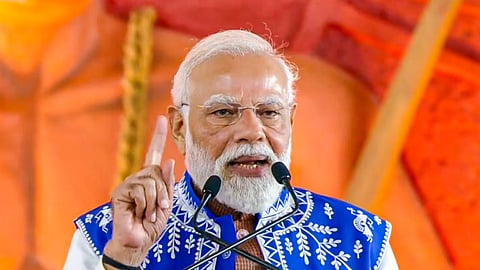

AHMEDABAD: Prime Minister Narendra Modi, speaking on Janjatiya Gaurav Divas on Saturday in Gujarat, launched a blistering political attack on the Congress.
He accused the party of abandoning tribal communities for six decades and failing to recognise their contributions. He highlighted the BJP’s record of expanding welfare spending, building institutions, and elevating Adivasi leaders to national prominence since 2014.
PM Modi also invoked history, stating that tribal sacrifices in the freedom struggle were suppressed to glorify 'a few families', and asserted that his government restored long-overdue honour to tribal icons and communities across India.
He also accused the Congress of “leaving tribal communities to their fate” during its six decades in power.
He said that malnutrition, poor health services, broken connectivity and the absence of education became the “forced identity” of tribal regions as previous governments refused to intervene.
“They sat idle while an entire community struggled,” he declared, linking each failure directly to Congress leadership.
PM Modi also recalled the political timeline, emphasising that it was only when Atal Bihari Vajpayee became Prime Minister that India saw the creation of a dedicated Ministry of Tribal Affairs, something he described as a “foundational correction” that Congress had never even attempted.
"Yet, once the Congress-led government returned to power, the ministry was reduced to a token department with only a small amount allotted for tribal welfare, stalling crucial development.
He said his government, since 2014, “increased the ministry’s spending several times,” building momentum for development in areas ignored for generations.
He linked the expansion directly to health reforms, stating that the government boosted medical facilities in tribal districts as they face the deadly threat of sickle cell anaemia.
He also linked welfare to empowerment, highlighting massive investment in sports infrastructure and reminding the audience that India’s World Cup-winning women’s team had “one proud tribal player” who symbolised rising representation.
Seamlessly shifting from welfare to recognition, PM Modi underscored how his government honoured Adivasi achievements long overshadowed by dynastic politics.
“In the pursuit of giving credit for independence to a few families, the sacrifice and dedication of my tribal brothers and sisters were ignored,” he said, expanding the critique into a broader historical narrative.
He argued that before 2014, icons like Bhagwan Birsa Munda “were not widely remembered,” but his government changed it so that the future generation would know the great gift our tribal brothers and sisters gave us.”
PM Modi pointed to the surge in tribal representation as evidence of this shift.
He recalled the Padma Shri awarded to Adivasi painter Paresh Rathwa and highlighted that India’s President today comes from the tribal community.
With the same breath, he cited the rise of leaders such as Odisha Chief Minister Mohan Charan Majhi, Chhattisgarh’s Chief Minister, who he said is driving transformative change, Nagaland’s Neiphiu Rio, who is “doing remarkable work,”.
He also mentioned Arunachal Pradesh Chief Minister Pema Khandu, who is “working tirelessly to develop his state.”
PM Modi said that it reflected a new era where tribal communities are not just beneficiaries, but leaders shaping India’s direction.
He noted that the tribal society’s roots extend “back to Lord Ram,” yet their place in India’s progress was never acknowledged by earlier governments.
By the end of his speech, PM Modi’s message wove together politics, history, development, identity and framed the BJP as the first party to give tribal communities both recognition and representation, portraying Congress as the force that kept them on the margins for decades.
Prime Minister Narendra Modi on Saturday inaugurated development projects worth over Rs 9,700 crore in Gujarat’s Narmada district, giving a major push to the state’s infrastructure drive.
Earlier in the day, he reviewed the construction progress of the bullet train station in Surat, an important node of the Mumbai–Ahmedabad High-Speed Rail Corridor, before heading to events commemorating the birth anniversary of tribal icon Birsa Munda.
