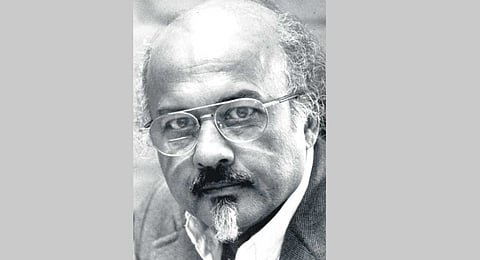

BENGALURU: Veteran journalist, writer and columnist, who was Director of Express Publications (Madurai) Private Limited and Editorial Advisor to The New Indian Express, Thayil Jacob Sony George—popularly known as TJS George or TJS—passed away on Friday afternoon at a private hospital in Bengaluru. He was 97. He is survived by his son Jeet Thayil and daughter Sheba Thayil. His wife Ammu George died in January this year.
Family members informed that TJS was ailing from age-related problems for some time, with his condition deteriorating over the last two months. He was admitted to Manipal Hospital in Bengaluru last week, and had undergone a minor surgery from which he was recovering. However, complications set in on Thursday and Friday, when he suffered two cardiac arrests, respectively, the second from which he did not recover. TJS passed away at 4.30 pm on Friday.
TJS was born on May 7, 1928, as the fourth child of Thayil Thomas Jacob, a magistrate, and Chachiamma Jacob, and went on to graduate from the Madras Christian College with an Honours in English Literature before embarking on his journalistic career.
TJS began his career in 1950 at The Free Press Journal in India’s Maximum City, then known as Bombay, now Mumbai. He went on to work with The Searchlight, the International Press Institute and the Far Eastern Economic Review before becoming the founding editor of Asiaweek, published from Hong Kong. At Searchlight, TJS became the first Indian editor to be charged with sedition in India. When he was arrested for his columns against then Bihar Chief Minister KB Sahay, the defence minister at that time, VK Krishna Menon, rushed to Patna to defend him.

During his long stint with The New Indian Express that spanned over four decades, TJS contributed 1,300 columns in the last 25 years before laying down his pen on June 12, 2022 with ‘Now is the time to say Goodbye’. His column ‘Point of View’ ran for over 25 years and was widely read.
TJS never took a backward step during the rest of his career too, never flinching from speaking truth to power. In his final column, TJS explained how he saw it: “Some of us feel that we should not criticise our own country. Some feel exactly the other way—that a big country like ours needs to be cautioned all the way about pitfalls. All arguments have their own supporters and their own critics, their own validities and their own drawbacks. But there is something not right if a country and its rulers start feeling that they should not be criticised at all—and especially by newspaperwallahs.”
He was honoured with the Padma Bhushan in 2011 for his significant contributions to literature and education, and was given the Karnataka Rajyotsava Award in 2007.
Some of the famous books that TJS wrote include: Lee Kuan Yew’s Singapore (1973), Revolt in Mindanao : the rise of Islam in Philippine Politics (1980), Pothan Joseph’s India (1992), The Life and Times of Nargis (1994), The First Refuge of Scoundrels (2003), MS, A life In Music (2004), Lessons In Journalism: The Story of Pothan Joseph (2007), M.S. Subbulakshmi: The Definitive Biography (2016), Askew: A Short Biography of Bangalore (2016), Jaya: An Incredible Story (2018), and The Dismantling of India: In 35 Portraits (2022).
TJS’ last rites will be performed in Bengaluru, where he will be cremated at the Hebbal crematorium on Sunday afternoon.