
CHANDIGARH: The Pentagon’s latest directive rolling back the move that allowed beards for soldiers in the US military has drawn flak from Sikh groups and political parties in Punjab.
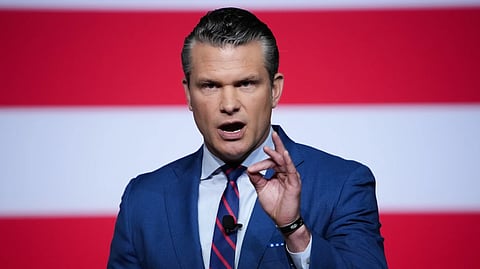
In his speech at Marine Corps Base Quantico, US Secretary of Defense Pete Hegseth had said, "If you want a beard, join special forces. If not, shave. We don’t have a military full of Nordic pagans." He added that the era of “rampant and ridiculous shaving profiles” through waivers for medical or religious reasons is over.
Hours after the address, the Pentagon issued a memo titled "Grooming Standards for Facial Hair Implementation", directing all branches to revert to pre-2010 standards, stating that facial hair waivers are generally not authorized. It mandates compliance plans within 60 days and full execution within 90 days, with limited exceptions for special operations forces during “validated mission-essential requirements” though even they must be clean-shaven before deployment.
Punjab assembly speaker Kultar Singh Sandhwan said the US government's decision to ban beards in the army is highly condemnable and unfortunate, adding that the move is an insult to the Sikh soldiers who fought in the World War. He highlighted that maintaining unshorn hair is an integral part of Sikh religious identity. He said the central government should immediately raise this issue with the US government so that the decision can be reversed.
Shiromani Akali Dal president Sukhbir Singh Badal has appealed to External Affairs Minister S Jaishankar to take up the issue with the US government to ensure Sikhs can practise their faith without any discrimination.
In a letter to Jaishankar, Badal said Sikhs all over the world were deeply anguished and concerned over US Secretary of Defense Pete Hegseth’s statement effectively banning beards for Sikhs serving in the US defence forces. He urged the minister to take up the issue at an appropriate level to ensure this discriminatory decision was not implemented and Sikhs continued to be allowed to practise their faith as before.
He said the decision ran against the principle of freedom to practise one’s religion, a cornerstone of US democracy. He said the US government had categorically acknowledged the right of Sikh members of the US armed forces to preserve their external symbols of religious identity including turban and beard, allowing a plea in 2010 by two Sikh officers, Capt. Simran Preet Singh Lamba and Dr. Maj. Kamaljeet Singh Kalsi.
Shiromani Gurdwara Parbandhak Committee (SGPC) general secretary Gurcharan Singh Grewal said it was deeply concerning news for the Sikh community. "This is highly unfortunate, and we categorically consider it to be unjust. In a democracy like the US, it is the government's duty to respect and uphold the religious freedoms of all persons, especially those belonging to minority communities," he said.
Stating that the SGPC is taking serious note of this development, he said they will first reach out to Sikh organisations in the US to gather complete and detailed information about the policy, adding that they will coordinate closely with them to assess the situation and determine the best course of action.
The North American Punjabi Association (NAPA) has expressed concern and opposition to this move. NAPA executive director Satnam Singh Chahal said, "The new rules state that facial hair waivers are generally not authorised. It would create serious implications for Sikhs, orthodox Jews, Muslims and other religious minorities whose faith requires them to maintain beards and other articles of faith."
Chahal said this move represents a betrayal of trust for those who have fought for years to gain religious accommodation in the armed forces. "This decision is not about discipline or lethality, it is about stripping away the dignity and religious identity of devout soldiers who serve this country with loyalty and honour," he said.
NAPA has called on the Donald Trump administration, members of Congress, and civil rights organisations to immediately intervene and halt the implementation of the Pentagon’s directive. It pledged to pursue all available advocacy through diplomatic channels to reverse what it described as a regressive and discriminatory policy.
The Sikh Coalition, a leading advocacy group for Sikhs in the US military, said it was "angered and deeply concerned" by this recent move. "At this time, we are on high alert,” the coalition stated, warning that the policy could force devout service members, hundreds of whom rely on waivers to wear beards, turbans, or other visible signs of faith, to choose between their beliefs and their careers. Community voices echoed the alarm, with one Sikh soldier tweeting, “My kesh is my identity. This feels like a betrayal after years of fighting for inclusion.”
Criticism has also emerged from other religious communities such as orthodox Jews, with payot and beards, and Muslims.
In 2010, the US Army granted its first formal religious accommodations in over two decades to two Sikh officers, Capt. Simran Preet Singh Lamba and Dr. Maj. Kamaljeet Singh Kalsi. These case-by-case waivers allowed them to wear turbans, maintain beards, and keep uncut hair, setting a precedent under the Religious Freedom Restoration Act (RFRA) of 1993. Then in January 2017, the Army formalized these relaxations through Directive 2017-03, updating regulations to create a “strong presumption” in favor of approving requests for turbans, beards, and other religious items. This policy shift ensured that Sikh soldiers could serve without needing to change their appearance.
Sikhs have served in the US military since World War I, with Bhagat Singh Thind becoming the first known Sikh to enlist in the US Army in 1917 and being granted permission to wear a turban while on active duty. This was an individual exception rather than a formal policy.
