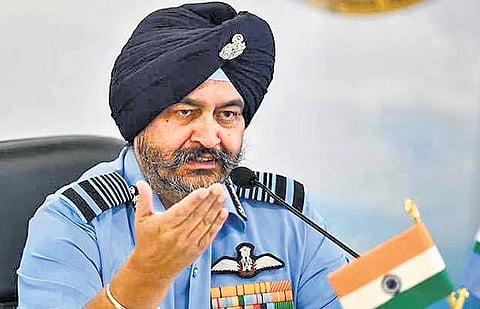

While batting for fifth-generation Advance Medium Combat Aircrafts, former Air Chief Marshal Birender Singh Dhanoa (Retd) tells TNIE that during Operation Sindoor, if the Close-In Weapons System were in place, not one Pakistani drone would have gone back, and if the Rafale had been available for Balakot Operation, the results would have been different. Excerpts:
Technology is changing fast, and what is needed to update IAF on equipment, training, and technology?
There is nothing new we have not already catered for. Now, after the Ukraine conflict, the world is talking of drones. The IAF has been using combat drones since 2001. When I was the Vice Chief in 2015, we initiated the process of developing a close-in weapons system (CIWS); its purpose was to strike and destroy all drones.
But what is the challenge with drones? Some of them are huge; you can hit them with a missile, but there is a cost-benefit ratio. The drone costs $1,000, and hitting it with a missile costs $1 million. That does not work out.
Secondly, small drones can be made, and these drones can carry a 5 to 10 kg warhead, which is good enough to kill a VVIP or destroy a tank. How do you counter these small drones? The CIWS is smart ammunition. So, you exactly know where the target is and how far it is and you can take out any drone with ease.
Unfortunately, our procurement process is taking too long. So, you incur an opportunity cost. When there is an engagement, you don’t have your technology with you. You have to take a call for national defence; these are needed to fight tomorrow’s war and so, fast-track them.
How did our air defense systems perform during Operation Sindoor ?
I cannot comment on that, as I was not the chief, and I do not know which systems performed against which drone. But if a close-in weapon system (CISW) were in place, not one Pakistani drone would have gone back.
IAF squadron strength has reduced to 29 as compared to the authorised strength of 42. How can the IAF cope with the emerging threats?
Everybody says that if Sukhoi-30 or Rafale is replacing the MiG-21, why do you need 42? One Rafale squadron may be capable of three or four MiG-21 squadrons, but that is not the answer. The answer is Rafale can only be at a particular place at one time; it cannot be everywhere. Look at our border; it starts from Karachi and extends up to Kashmir, and runs right up to the Northeast. Number two, we need numbers for that. It is a very capable aircraft, but can it be in one place?
Then there is the attrition rate. I have always said we are not capable of fighting a two-front war with the number of squadrons we have. It means you want to do the full spectrum of operations: air defence, close air support, counter air, everything you want us to do, then we need 42 squadrons. Which country in the world has two adversaries that are nuclear-armed? Nobody. You cannot compare us with anyone else. The West looks at enemies thousands of kilometres away, but ours is next door.
IAF recently asked for more Rafale fighters. Should we focus more on our indegenous projects?
We have the most diverse inventory in the world; we should not keep increasing the types of aircraft. However, to bolster our air power, a high-end aircraft, such as a Multi-Role Fighter Aircraft, is an absolute necessity; otherwise, how will we engage in high-end fights? In my personal opinion, more Rafales would be the most logical answer, but you need to push for Advanced Medium Combat Aircraft, as it is a fifth-generation fighter jet, and the future lies there.
Where does Tejas LCA stand in comparison with its counterparts?
Tejas LCA is a good aircraft. It is supposed to have good systems. Unfortunately, Tejas, in my opinion, at least till I retired, was not ready. Why did you think Abhinandan was flying a MiG-21 Bison, and why weren’t we flying the Tejas? It did not have all the bells and whistles at that particular time; I do not know what has happened now. At that particular time, it did not have self-protection jammers or flares; it also lacked a beyond-visual-range missile, which the Bison possessed.
The question is not whether Tejas is a good or bad aircraft; the question is whether Tejas is ready; the delivery has not been made. Look at the opportunity cost we paid. In Balakot, we were supposed to have 27 Mirage 2000s, which were upgraded and were almost equivalent to F-16s of Pakistan. We had only seven of them, so who paid the opportunity cost? We. Hindustan Aeronautics Limited should have provided us with all 27 of them as per the schedule. What about the accountability of the people who are supposed to deliver? Most important is whether you are holding them accountable.
There is talk of Russia offering Sukhoi-57 fighters. Do you think it is a viable option for India?
We provided an opinion to the government about the Sukhoi-57 when I was the air chief, but the opinion is classified.
