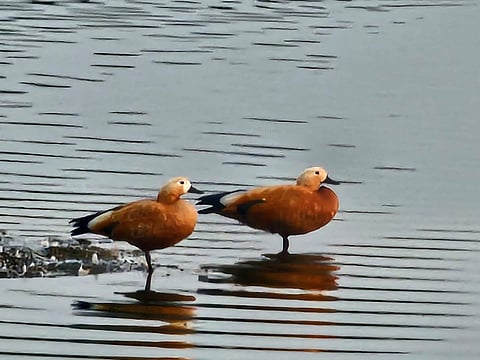

DEHRADUN: Following the season's first snowfall in the higher Himalayan reaches of Uttarakhand late Monday, a sharp drop in temperatures across the plains has heralded the arrival of migratory birds to the state. A significant contingent of rare ruddy shelducks (surkhab), among the first arrivals, was spotted at the Asan Wetland—Uttarakhand’s first Ramsar site and conservation reserve—on Tuesday.
A flock comprising 32 members of the distinctively colored waterfowl was recorded landing at the Asan Barrage, located at the confluence of the Yamuna and Asan rivers in Dehradun district, around 11:00 AM.
Pradeep Saxena, bird expert and forester of the Asan Range, told TNIE, "Our count using binoculars confirmed the arrival of this first batch of 32 rare ruddy shelducks. We anticipate more flocks of their kind arriving within the next few days."
The Asan Wetland, situated about 40 km from Dehradun city near Vikasnagar, typically welcomes these avian visitors from cold regions like Siberia in the first week of October. The birds stay until March, returning to their native lands as summer approaches.
To prepare for the influx, authorities are currently undertaking maintenance work. "The bird-watching towers are being cleaned, and the mudflats are being repaired," Saxena noted. These mudflats are crucial as they create an optimal environment for the migratory birds, making it easier for enthusiasts and photographers to observe them.
The arrival of the ruddy shelduck is significant as they are usually the first species to migrate to the area, instantly drawing attention due to their striking, gold-gleaming plumage. Divisional Forest Officer of Chakrata Forest Division, Vaibhav Kumar Singh, recently visited the wetland, instructing staff to clear overgrown bushes and restore old mud structures.
The 444.4-hectare Asan Wetland, established as a conservation reserve in 2005, is a biodiversity hotspot. It hosts a wide array of species, including the painted stork, Eurasian wigeon, gadwall, and various cormorants and herons.
A particularly noteworthy resident is the Pallas’s fish eagle. According to Saxena, a pair of these eagles has been nesting here every winter for the last 60 years, favoring the highest branches of the semal tree due to their aversion to human interference.
"The Pallas’s fish eagle, easily identifiable by its white head and tail band, attracts large numbers of bird lovers annually," Saxena added. This bird also holds cultural significance; ancient legends describe it as a symbol of good fortune and eternal love, said to be two lovers transformed by the Gods who remain eternally separated by a river bank.
