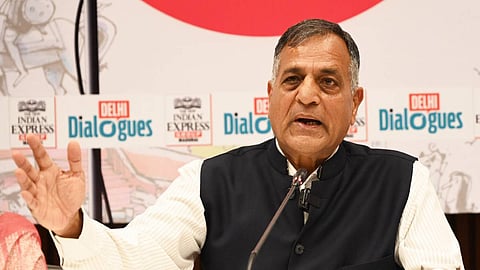

Former Election Commissioner, Ashok Lavasa, IAS (retd.), says the Election Commission of India’s Special Intensive Revision (SIR) of the electoral rolls in Bihar was “abrupt, aggressive and ambitious” and “avoidable” at this point in time. Answering a range of questions over the controversy the exercise generated, he says that it is for the Commission to clarify the procedure it will adopt for the nationwide SIR. Excerpts:
Preetha Nair: What is your opinion about Bihar SIR?
I have gone on record to say that this particular exercise was, in my opinion, abrupt, aggressive, and ambitious. And because of all three reasons, I said that it was avoidable at this point in time. And the reason why I said these three things can be understood if you look at three perspectives. What was the purpose of the special intensive revision? What were the principles that were followed, and what was the procedure that was adopted? So, if you look at all three dimensions, then many things become clearer.
The SIR is not a phrase used in the Act or the rules. When you look at the notification of June 24, people started analysing the principles behind this revision, and I think there are two things that created difficulties. In none of the previous revision exercises did the ECI do what they did in this SIR. Then they said that all the voters or electors on the roll as of 2003, in their case, have probative evidence of eligibility. But they also said there is a presumption of citizenship. Whether the ECI has employed this phrase in the revision exercise or even in the enrollment exercise that we are ascertaining and certifying your citizenship, they have never stated this.
Also, the ECI (told the Supreme Court) that if someone is not found in the electoral roll, it does not mean they lose their citizenship. But look at it from this way that if there were at that point in time more than 3.5 crore voters who, according to ECI, had been enrolled after 2003, and ECI is saying that pre-2003 there is a presumption of citizenship, which implies that post-2003, unless we are satisfied with your documents, we do not treat you as a citizen. So, I think this was problematic.
The other thing is that from the beginning, the approach in India has been for the machinery to go to the people and enroll them. The onus has never been on the citizen to apply, saying, please enroll me.
The procedure used for this SIR is different from the previous intensive revision. The order announcing the intensive revision, which also provided the procedure, is unfortunately not available in the public domain. So, nobody can say with certainty that this was a procedure followed in the past and now differs. I think the ECI should have clearly informed the people about any changes in the procedure.
Also, there were reports that the 11 documents are hardly available to people, or only a large percentage of people possess these documents. So, the ECI changed its procedure again. And there were several other procedural issues.
PN: What mechanisms should be in place to ensure fairness and accuracy?. Do you think the modifications of the SIR made the voter list more inclusive and less exclusionary?
The Supreme Court asked the ECI to publish a list of all the 65 lakh voters who were deleted from the draft roll and give the reasons for the deletion. The SIR that ECI treated it as a de novo publication of electoral rules, stating that if we are publishing the rules de novo, we are not obliged to provide reasons for excluding anyone not mentioned. I have the full right to know why my name is being accepted, which is why the Supreme Court stated that you must provide the reasons.
The test, ultimately, is whether these people, whose names have been deleted, will come forward to say that my name should be included again because it has been wrongly deleted. So that is a question which I think all of us, whether you are pro-SIR or against SIR, have to address. If somebody’s name has been deleted because it was earlier enrolled, but now he did not submit his form, that person should come forward and say that their name has been deleted.
There are allegations that SIR was brought out under pressure from corridors of power. Did you face any pressure during your tenure?
The way I look at it, it is perfectly understandable for people to say what they want from you. But ultimately, it is for me to decide what I want to do because I am supposed to fulfil a constitutional job. If, let’s say, political parties come to you with a demand, and the opposition does the same, it is not pressure. However, if the ruling party comes to you with that demand, it is pressure. So, ultimately, I think it depends a lot on how people understand their role. And for doing the right thing, why should I be under pressure?
Rajesh Kumar Thakur: Does India need an exercise like SIR?
I said that the election commission does have the authority to carry out a revision in the manner that it deems fit. That is what the Act says. And that is why I do not think the court has questioned the Election Commission’s authority to carry out an intensive revision.
Can an election commissioner truly function independently, given the structural hierarchy and political pressure?
If there is a fault at all, it lies with the individuals discharging that responsibility. This question has gained currency in the last two years following the Supreme Court judgment, which came because there was a provision in the constitution for making rules that have not yet been made. And the Supreme Court said there will be a selection panel in which the Chief Justice will be there. There will be two others — the Prime Minister and the Leader of the Opposition — until the Parliament makes rules. So, Parliament made rules. I think my view on the matter is that the government lost an opportunity by not broadening the selection process. If the Chief Justice had continued, all these questions would not have arisen. If you broad base the selection process, then it gives more confidence to people.
Santwana Bhattacharya: Was SIR necessary as the Bihar polls are around the corner?
I think the process of reviewing, removing voters, or admitting new voters is available even if you don’t conduct SIR. The summary revision, conducted in Bihar, led to the publication of rules in January 2025. According to the Act, in any state where an election is impending, a summary revision must occur. The summary revision was carried out at the end of 2024, and the rule was published in January 2025. Now, during the special intensive revision, if you say that 22 lakh voters have died, does it mean that they have died after January 2025? That data is not available.
That could only mean the earlier exercises were probably not done with proper diligence. And in this case, that is why I am saying that ECI could provide a good justification for employing this process. According to this process, if I give you a form and you don’t exist, your form will not come back, and I’ll delete your name. Whereas the established procedure is that even when somebody was reported to be dead, ECI would give a notice lest somebody should be giving you false information. If you are recorded as dead, that does not mean that ERO has the authority to delete your name directly unless he has followed the procedure of giving notice that this is the person who is reportedly dead.
SB: In the 2011 Bengal elections, one of the most well-known EC officials, K.J. Rao, had made this statement, which became very controversial at one point, and was discussed and made headlines. He had said that Bengal electoral rolls had to be cleaned out, Bangladeshi entrants had to be cleansed out to ensure Bengal had a free and fair election. So, is it a failing of the EC or a technological situation that we have not been able to evolve a system whereby the deletion of dead voters becomes automatic and manageable?
The point is, what are the reasons for an electoral roll to change? One, clearly, as you said, is death. The legal process involves registering, tracking the registration of deaths and births, and getting a death registered. Is it followed 100 percent? Maybe now, yes. There were times when people would not care to register, or the system was not in place.
But automatically, there was no provision. Even today, there is no provision that, because you register a death, the death registration system will speak to the electoral registration system, and there will be an automatic deletion.
The second is migration. Do we have a system for registering migrants? You don’t register it anywhere. So, how would the EC incorporate such a safeguard? And that is why I said that any exercise of purification or updation has to be through a door-to-door survey where a functionary goes.
So, the entire thinking of the ECI has been that exclusion should become difficult. Inclusion should become easy. There are so many people who are migrating from one place to another. There are so many people who are illiterate. How do you protect? How do you give them their voting rights? Make it as easy as possible for them to enrol.
It is the state’s function to determine the citizenship of individuals or to prevent people from coming into the country. That is their responsibility. It may be a problem, but why should an organisation that is not equipped to handle this undertake this job? That is the question. By the way, there are countries where the ECI has been given this responsibility.
SB: And we are going into a countrywide SIR. How can it be ensured that this doesn’t happen?
The ECI’s priority is not to delete voters. Their priority should be to include voters. Then, based on the insights we have from Bihar SIR, can we evolve a more user-friendly procedure? So, I would feel that based on whatever ECI has learned, whatever inputs it has received from people, and whatever the courts direct, they should now draft another guideline for carrying out SIR if it has to be conducted throughout the country. And yes, I don’t mind actually if an SIR exercise is conducted. The draft guidelines should be discussed with all stakeholders, as this is what we intend to do.
After all, cleaning up the electoral roll isn’t a surprise check, nor is it like some enforcement exercise you suddenly want to do. So, after discussing these guidelines with the stakeholders, you finalise them. I would say that once the guidelines are followed, spend 3-4 months just carrying out a campaign. Tell people that this is the purpose of our exercise.