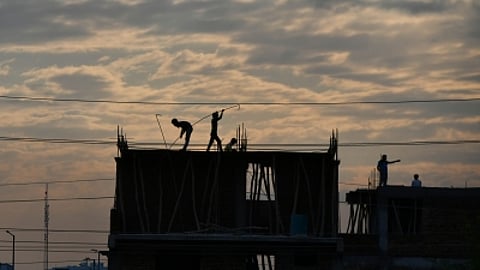

AHMEDABAD: A new study has revealed how Gujarat’s construction boom—powered by advanced systems like precast technology, RMC plants, and steel-aluminium formwork—is quietly pushing women to the margins.
As machines replace manual tasks such as stone crushing, plastering, and concrete mixing, women are being stripped of roles, wages, and visibility. Automation has reduced their participation by nearly 80%, locking them out of skilled, better-paid technical jobs. Behind the glittering skyline, technology is not only reshaping construction—it’s also rewriting gender power dynamics in the industry.
The construction boom in Ahmedabad is no longer just about cranes, cement, and concrete. It is now a story of power, technology, and exclusion.
Released on October 14, 2025, the research report “Building Futures: Women Workers at the Margins of Construction Automation” by Dr. Geeta Thatra and Saloni Mundra captures this reality with startling clarity. Conducted between December 2023 and February 2025, the study spans major construction and manufacturing sites—from high-rise projects and infrastructure corridors to AAC block and precast factories—tracking how automation is redrawing the gender map of labour.
India’s construction sector employs over 68 million workers, including 7.6 million women, and contributes nearly 9% to the nation’s GDP. Yet, as advanced technologies like precast systems, ready-mix concrete (RMC) plants, and steel/aluminium formwork become more prevalent, traditional roles once occupied by women—such as stone crushing, load carrying, concrete mixing, and plastering—are being systematically eliminated. These machines do not merely replace tasks; they restructure hierarchies.
For women on-site, this change has come wrapped in exclusion.
“As a woman, you shouldn’t touch machines,” said Deepti*, a 30-year-old from Dahod.
“You are only meant to be a helper,” added Suguna Ben*, a 35-year-old with 15 years of experience.
(*Names changed to protect identities.)
Their voices, echoed across multiple sites, expose the persistent gender bias that denies women access to skill-building and upward mobility.
The data is stark. Automation has cut women’s participation by nearly 80% in material handling and concrete production. Contractors increasingly favour long-distance male migrants over tribal and women workers, who have long been the backbone of Ahmedabad’s construction workforce. The exclusion is both economic and social: women earn 10–20% less than male “helpers” and almost half of what male “skilled” workers are paid, despite having comparable experience. In many cases, wages are handed over to male family members, effectively erasing women’s economic agency, the report says.
At a precast yard, a supervisor’s comment laid bare the industry's gender bias: “We don’t want to spend energy on matters like harassment and women’s safety.”
Such attitudes have calcified into hiring practices, where workplace safety and dignity are treated as afterthoughts, and women are systematically excluded from higher-paying, technical roles.
The study doesn’t just map displacement—it confronts it. It warns that without intervention, technological progress will deepen gender inequality rather than reduce it. The report calls on Gujarat’s Labour Department and the construction sector to: Invest in gender-responsive skilling for emerging technologies, set clear employment targets for women in public infrastructure projects, enforce workplace dignity through POSH Act compliance and basic facilities and, guarantee universal social protection for migrant workers
On the ground, women are eager to learn—but denied the opportunity.
“Since big machines have come, Tribal women like us don’t get much work. But if we are given the chance to learn new skills, we too can advance in construction,” said Savita ben, a 48-year-old worker.
Surekha ben, 38, shared a similar experience: “Even though I know plastering and can operate a breaker machine, I earn only half of what my husband gets because I’m not seen as a karigar (mason).”
Dr. Geeta Thatra emphasized: “Automation need not always mean displacement. Now is the time for the construction industry to reimagine women’s inclusion.”
Co-author Saloni Mundra added the structural dimension: Industrialisation has led to outsourcing and the inflow of trained male migrants. Bhil Adivasis and women are being systematically pushed out of the very industry they built with their labour.”
Behind Ahmedabad’s gleaming skyline lies a widening gender gap. As machines shape the city’s future, the real challenge is to ensure women are not written out of it.
