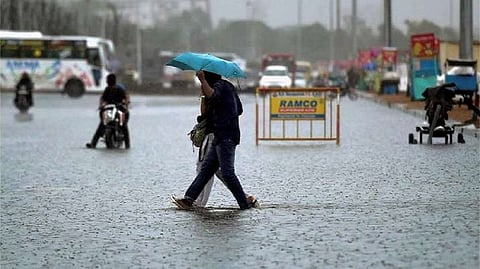

The Southwest Monsoon (SWM) finally withdrew from the entire country on October 16, just a day later than its usual date of October 15. Simultaneously, the Northeast Monsoon rains commenced over Tamil Nadu, Puducherry-Karaikal, Coastal Andhra Pradesh, Rayalaseema, South Interior Karnataka, and Kerala-Mahe.
The Indian Meteorological Department (IMD) reported that neutral El Niño-Southern Oscillation (ENSO) conditions are currently prevailing over the equatorial Pacific region. They forecast an increased possibility of La Niña conditions in the coming months, which is expected to result in an above-normal Northeast Monsoon and a colder spell in winter.
The rain-bearing SWM contributes 75-86% of India's total annual rainfall, covering over 70% of the country’s geography between June 1 and September 30. This season, the SWM delivered an 8% surplus rainfall, with India recording 937.2 mm against a normal of 868.6 mm.
Despite the overall national surplus, East and Northeast India received 1,089.9 mm of rainfall, which is 20% below the normal of 1,367.3 mm.
The monsoon arrived early this year, making its onset on May 24, ahead of the scheduled date of June 1. This marks the earliest onset over the Indian mainland since 2009, when it arrived on May 23. The primary rain-bearing system typically makes its onset over Kerala by June 1 and covers the entire country by July 8. It usually starts retreating from northwest India around September 17 and withdraws completely by October 15.
In the last two decades, however, the monsoon has tended to delay its withdrawal, with some years extending into late October, such as in 2020.
Now that the Southwest Monsoon has officially withdrawn, the Northeast Monsoon season has begun over peninsular India, typically occurring between October and December. This season primarily brings rainfall to the southern parts of the country, especially Tamil Nadu.
Current forecasts from the latest Monsoon Mission Climate Forecast System (MMCFS) and other climate models continue to indicate an increased likelihood of La Niña conditions in the upcoming months.