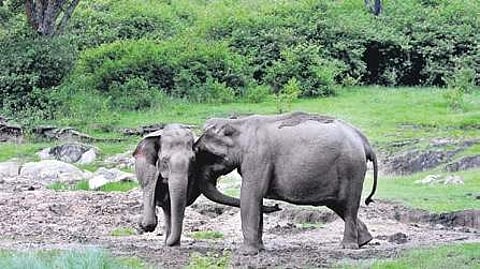

DEHRADUN: Uttarakhand, already renowned for its tiger population, has further solidified its reputation as a biodiversity hotspot by securing the fifth position nationally for its elephant numbers.
The state boasts an encouraging population of 1,792 elephants, according to a newly released synchronized estimation report.
The findings, unveiled during the 36th Annual Research Symposium at the Wildlife Institute of India (WII), confirm Uttarakhand’s strong presence among India’s megafauna states. The state currently ranks third nationally for tigers, and the new elephant tally places it firmly in the top five.
The All India Synchronised Elephant Estimation Report estimates the total wild elephant population across India at 22,446. Karnataka leads the count with 6,013 elephants, followed by Assam, Tamil Nadu, and Kerala.
Significantly, this estimation marks a methodological leap forward. Senior scientist at WII, Dr. Vishnu Priya, highlighted the advanced technique used.
“This time, the elephant count was based on scat analysis (DNA-based estimation). This method is far more accurate,” Dr. Priya told the TNIE. “This is the first time such a precise method has been applied across any state in the country. Previously, assessments relied solely on direct observation.”
The extensive data collection for this report was carried out across 2022 and 2023. Officials noted that the new methodology provides a more robust baseline compared to the previous 2017 report, which had estimated the national population at 29,964.
Despite the positive census figures, conservationists caution that the rising elephant numbers underscore the escalating human-wildlife conflict in the Himalayan foothills.
Department sources indicate that since the formation of Uttarakhand, conservation efforts have been significant. However, the toll on elephant lives remains alarming.
Between 2001 and October of this year, 538 elephant deaths were reported in the state. A major concern is the number of unnatural fatalities: 167 elephants died due to external factors, including 52 electrocutions, 32 collisions with trains, 71 road accidents, and nine due to poaching.
The data reveals that 102 elephants succumbed to infighting, while 277 died of natural causes. The human cost of this coexistence is equally stark. Over the past 15 years, 148 human lives have been lost due to elephant attacks across the state.
“While the elephant population is growing—a testament to successful habitat management—the parallel rise in conflict deaths, both human and elephant, presents a critical conservation challenge,” stated a senior Forest Department official on condition of anonymity. “For every 538 elephants lost, 148 people have died. We must urgently address mitigation strategies.”
The report was formally released by key dignitaries, including SP Yadav, Director General of the International Big Cat Alliance, and Ramesh Pandey, Additional Director General of the Ministry of Environment, Forest and Climate Change.