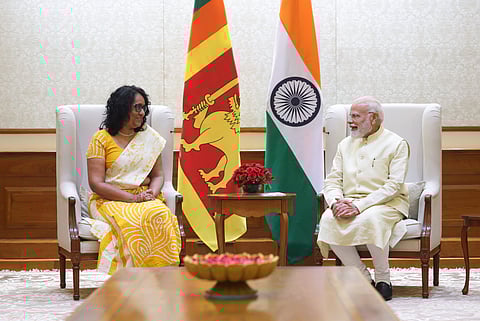

NEW DELHI: Prime Minister Narendra Modi and visiting Sri Lankan PM Harini Amarasuriya held comprehensive talks on Friday, focusing on strengthening cooperation across multiple sectors and addressing the sensitive issue of Indian fishermen's welfare.
According to a post by PM Modi on X, the meeting between the two leaders covered a “broad range of areas,” including education, women's empowerment, innovation, and development cooperation. Importantly, the “welfare of our fishermen” was also a key discussion point, underscoring the ongoing challenge in maritime boundary issues.
Calling Sri Lanka a "close neighbour," Modi stressed the “immense importance” of their cooperation for the prosperity of the people of both countries and the shared region.
The meeting with Prime Minister Modi followed Amarasuriya's discussions on Thursday with External Affairs Minister S Jaishankar. Dr Jaishankar had said that their talk centred on India’s continued support to Sri Lanka and bolstering cooperation in education and capacity building.
The high-level engagements reaffirm India's 'Neighbourhood First' policy and signal a renewed momentum in the strategic partnership between New Delhi and Colombo.
Prime Minister on Thursday also met Egypt’s Foreign Minister Dr Badr Abdelatty and applauded President Abdel Fattah El-Sisi's “crucial role” in securing the recent Gaza Peace Agreement, calling it a “vital step” toward regional stability.
The meeting took place as part of the inaugural India–Egypt Strategic Dialogue, a high-level review aimed at accelerating cooperation under the strategic partnership signed last year. Following the talks, PM Modi posted on X that the partnership continues to "grow from strength to strength," citing progress in trade, technology, energy, defence, and people-to-people exchanges.
Abdelatty also made a sharp contextual assessment, stating that resolving the Palestinian question is key to making progress on the ambitious, US-backed India-Middle East Economic Corridor (IMEC) during a press meet.
The IMEC, announced in September 2023 as an alternative to China's Belt and Road Initiative, aims to connect India to Europe via sea and rail through the UAE, Saudi Arabia, Jordan, and Israel.
“The IMEC is an important project but we have to understand that... escalation [in the region] could hinder the cooperation, the connectivity," Abdelatty told reporters, adding that "connectivity is very important as part of a final settlement of the Palestinian cause." He confirmed that Egypt, a critical transit nation, is open to joining the multi-nation project.
The Egyptian foreign minister also quantified the significant economic impact of the regional conflict. He revealed that Egypt has suffered losses exceeding $9 billion since the Iran-aligned Houthi group began targeting ships in the Red Sea in solidarity with Palestinians.
"We are paying a heavy price," Abdelatty said, noting that the daily number of ships crossing the Suez Canal has dropped by at least 60%, from about 75 ships to a maximum of 25 to 50.
During his visit, Abdelatty actively sought to boost economic ties, announcing that Egypt is encouraging the establishment of an “Indian industrial zone alongside the Suez Canal Economic Zone.”