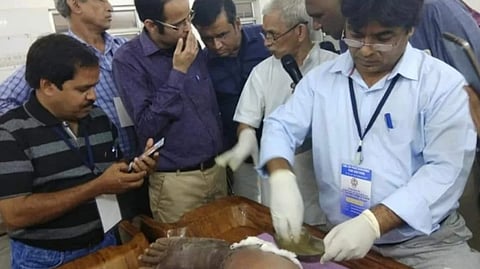

DEHRADUN: The creature once notorious for clinging to human skin and sucking blood in the Himalayan foothills—leech, scientifically known as 'Hirudo medicinalis'—is now being harnessed as a powerful tool for public health improvement. The traditional practice of Leech Therapy, or 'Hirudotherapy', has gained momentum at the Ayurvedic Hospital in Chamadakhan, Ranikhet, promising relief for various ailments.
This 5,000-year-old ancient methodology, endorsed by Ayurvedic practitioners, is touted as entirely natural and safe. It is proving particularly effective in treating conditions such as dermatological issues, poor blood circulation, gangrene, eczema, and hair problems. The core principle involves drawing out contaminated blood from the body, which subsequently reduces inflammation and pain.
Dr Mohammad Shahid, the District Ayurvedic and Unani Officer of Almora, spoke exclusively to The New Indian Express about the therapy’s mechanism. "Leech therapy is also known as Hirudotherapy," Dr Shahid explained. "The leech used in this process is considered a hematophagous organism. The biologically active compounds present in the leech's saliva and secretions are useful in treating various diseases."
Dr Shahid emphasised the crucial distinction between different leeches. "There are two types of leeches: poisonous and non-poisonous. Only non-poisonous leeches, found in pure water sources, are used in this therapy. Locally, they are known as 'Kapila' or 'Sawari'." The leeches, which typically survive for five to six months, cannot be sourced locally for hospital use.
"The leeches kept here for treatment in Uttarakhand's Ayurvedic hospitals are procured from Aligarh, Meerut, and Delhi, where specialised breeding farms exist," Dr Shahid noted, adding that "one leech costs approximately 150 to 200 rupees."
The procedure itself is swift and carefully managed. "After obtaining the patient’s consent and conducting necessary tests, the leech is applied to the skin of patients suffering from skin diseases, hair problems, psoriasis, gangrene, or eczema," Dr Shahid elaborated. "In about 15 to 20 minutes, it either drops off on its own after sucking the contaminated blood, or it is removed from the patient’s skin using turmeric powder."
This method, known in traditional terms as 'Raktamokshana Chikitsa' (bloodletting therapy), is believed to do more than just purify the blood. Physicians state that by removing toxins, the therapy also strengthens the patient's immune system, leading to renewed energy and comfort.
Dr Jitendra Kumar Papnoi, Medical Officer at Chamadakhan, Ranikhet, affirmed the renewed focus on this ancient treatment. "Leech therapy is a natural, traditional, and effective medical system. Patients are finding relief from various ailments, and this treatment is also safe," he stated.