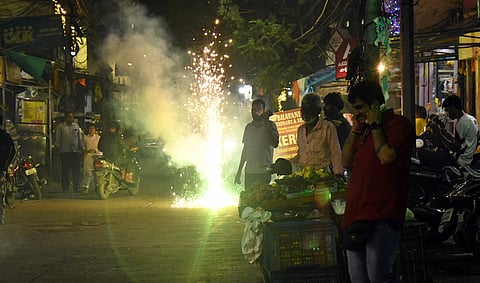

DEHRADUN: The lingering haze from Diwali fireworks has plunged Uttarakhand's air quality into a dangerous zone, with the state capital, Dehradun, recording 'severe' pollution levels on Tuesday morning.
According to data from the Central Pollution Control Board (CPCB) and AQI India, Dehradun registered an Air Quality Index (AQI) of 261.
This severe reading was mirrored across the state, with Haridwar and Kashipur also reporting significantly poor air conditions.
Monitoring stations in Dehradun revealed shocking figures. PM2.5 concentrations peaked at 184 micrograms per cubic meter, while PM10 levels surged to 230 micrograms per cubic meter - exceeding far beyond the safe limits.
"Despite clear daytime skies, cold air and low wind speeds are trapping pollutants near the surface," explained an environmental analyst. "This is creating a health hazard, especially for those with respiratory issues."
The pollution crisis extended beyond Dehradun. Haridwar recorded an average AQI of 182, and Roorkee hit 176, both falling into the 'unhealthy' category. Rudrapur and Kashipur remained in the 'poor' range with AQIs above 150.
Rishikesh, the spiritual town, saw its AQI hover around 179 on Monday evening, marking a volatile trend after fluctuating between 153 and a low of 63 earlier this month.
While acknowledging the poor readings, state officials highlighted Uttarakhand’s performance relative to other major north Indian cities.
A government spokesperson noted that Delhi recorded an AQI of 351 ('very poor'), Lucknow 250, Patna 226, and Bhopal 235 on the same Diwali day. "Uttarakhand's cities have performed better overall, demonstrating our commitment to cleaner air," the spokesperson stated.
Chief Minister Pushkar Singh Dhami emphasised a long-term vision.
"Our goal is to ensure clean air not just during festivals, but year-round. This year’s results prove that real change is possible through innovation, awareness, and collective participation."
Uttarakhand Pollution Control Board (UKPCB) Chairman, RK Sudhanshu, credited recent interventions for mitigating the worst effects.
"This year's cleaner Diwali is a result of collective effort," Sudhanshu stated. "Drone-based water sprinkling, new mechanical sweeping machines, and intensive awareness campaigns in schools have shown a concrete impact."
Specifically, drone-based water sprinkling helped control PM10 levels in Dehradun. Furthermore, the deployment of mechanical sweeping machines - procured under the National Clean Air Programme (NCAP) in collaboration with the CPCB - significantly reduced road dust in Dehradun and Rishikesh.
