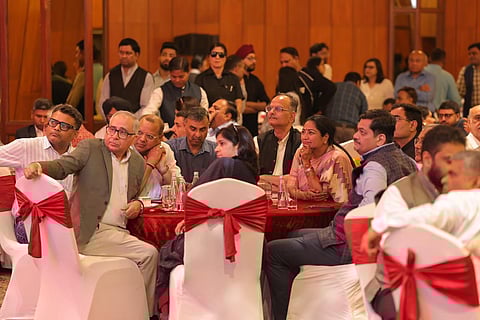

Urdu journalists have alleged discrimination and exclusion from a Diwali event that Chief Minister Rekha Gupta described as an opportunity for amicable dialogue with the media.
According to a report by The Wire, the Directorate of Information and Publicity (DIP) of the Delhi government invited journalists from both print and electronic media for a special interaction with the Chief Minister on October 13. The event, titled "Diwali Mangal Milan," was attended by all ministers of the Delhi Cabinet.
Reports suggest that attendance at the event was strictly by invitation. While invitations were sent via WhatsApp by DIP Director Sushil Singh, none of the Urdu media journalists — including those who regularly cover the Delhi government and the BJP — received one.
Against this backdrop, The Wire reported that journalists are likely to formally raise the issue with the Delhi government’s Public Relations and Development Authority.
Sadiq Sherwani, editor of the Urdu newspaper Hamara Samaj, who reported this incident, told The Wire in an interview that the first BJP government in Delhi in 1993 did not discriminate against the Urdu media and that times have changed now.
"While Urdu is not solely the language of Muslims, the BJP aims to project the notion that it is the language of Muslims," he said.
Sherwani also dismissed the possibility that the exclusion was a human error or an oversight. He said that at least one journalist from an Urdu media organisation would have attended the event if that had been the case.
Reacting to this incident, Aam Aadmi Party leader, Imran Hussain, accused the BJP of engaging in communal politics. “The step-motherly treatment of Urdu journalists will not be accepted," he said.
'No govt patronage for Urdu newspapers'
According to a report by Al Jazeera, industry data shows a 25 percent drop in Urdu newspaper circulation from 2018 to 2022, despite an overall growth in newspaper circulation in India.
Urdu newspapers have struggled to attract advertisements and government patronage.
“The fact is that Urdu newspapers do not get commercial ads. Companies don’t give us advertisements, whatever the reason may be,” Abdul Khaliq Ehsani, editor of Pindaar, a Patna-based daily was quoted as saying by Al Jazeera. “Only those newspapers which have government advertisements can flourish; otherwise, there is no scope," he added.
Umar Ashraf, editor of Heritage Times and a researcher on Urdu traditions, said in the report that the perception associating Urdu journalism solely with Muslims has hurt its circulation. “Urdu journalism is unfortunately now being associated only with Muslims. That costs it dearly,” he said.
“The first Urdu newspaper was published by a Hindu. Sikhs, Hindus and Muslims were all part of it. But after the 1940s, Urdu started being seen only as a Muslim language. That perception hurts it deeply," he said.