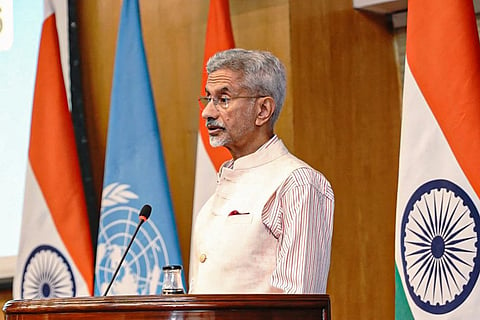

NEW DELHI: External Affairs Minister Dr S Jaishankar on Friday said that “all is not well with the UN,” accusing a sitting member of the United Nations Security Council (UNSC) of shielding a terror organisation responsible for the recent Pahalgam attack.
Speaking at an event marking the 80th anniversary of the United Nations, where he unveiled a commemorative postage stamp, Jaishankar said, “Few examples are more telling about the challenges facing the UN than its response to terrorism.” He questioned the credibility of multilateral institutions, asking, “When a sitting Security Council member openly protects the very organisation that claims responsibility for barbaric terror attacks such as at Pahalgam, what does it do to the credibility of multilateralism?”
The remarks came in the aftermath of the April Pahalgam terror attack that killed 26 civilians. The Resistance Front (TRF), a proxy of the banned Lashkar-e-Taiba (LeT), had claimed responsibility. The group, which operates from Pakistani soil, was named in a July UNSC report for its role in the attack. However, diplomatic sources said Pakistan had lobbied to remove references to TRF from the Council’s press statement condemning the assault.
Jaishankar, without directly naming Pakistan, made clear references to Islamabad, noting that certain states continue to block UN efforts to sanction known terror groups. “If victims and perpetrators of terrorism are equated in the name of global strategy, how much more cynical can the world get? When self-proclaimed terrorists are shielded from the sanctioning process, what does it say about the sincerity of those involved?” he said.
Pakistan currently holds a non-permanent seat on the 15-member Security Council, which includes five permanent members—China, France, Russia, the United Kingdom, and the United States—and ten elected members serving two-year terms.
Reiterating his frustration with the inertia of global institutions, Jaishankar said, “All is not well with the UN. Its decisions no longer reflect the priorities of the world. In an era of conflict, there is a need for peace, and yet the very institution founded to preserve peace is struggling to act decisively.”
He also cautioned against the “politicisation of multilateralism,” where powerful nations exploit global platforms to advance narrow strategic agendas. The Minister reaffirmed India’s commitment to peacekeeping, counterterrorism, and equitable global governance but stressed that meaningful reform is vital if the UN is to restore its legitimacy.
