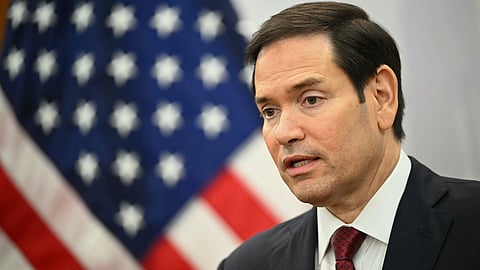

NEW DELHI: The United States is looking to expand its strategic partnership with Pakistan, but not at the cost of its ‘deep’ relationship with India, US Secretary of State Marco Rubio said, in apparent bid to calm concerns in New Delhi over Washington’s renewed outreach to Islamabad.
Speaking to reporters, Rubio stressed that both India and the US maintain independent relationships with different nations, describing this as “part of a mature, pragmatic foreign policy.”
“Just like India has ties with countries that the US doesn’t, the vice versa applies,” Rubio said. “I don’t think anything we’re doing with Pakistan comes at the expense of our relationship or friendship with India, which is deep, historic, and important.”
Rubio is expected to meet External Affairs Minister S Jaishankar on Monday on the sidelines of the ASEAN Summit in Kuala Lumpur. It will be the fourth in-person meeting between the two leaders this year, a sign of high-level engagement continuing despite friction over trade and energy issues.
The Jaishankar–Rubio meeting is expected to cover trade negotiations and India’s continued imports of Russian oil, a major friction point for the Trump administration.
The Secretary of State’s comments come amid Washington’s efforts under President Donald Trump to recalibrate ties with Pakistan including deals on critical mineral mining and energy cooperation, a move that has raised eyebrows among the policy makers in New Delhi.
Trump’s administration has also maintained high tariffs of 50 per cent on key Indian exports, while Islamabad continues to enjoy preferential treatment in some sectors.
Both India and Pakistan had a brief military showdown following Pahalgam terror attack which made Trump claim that the US trade leverage helped secure a ceasefire, a claim India flatly and consistently rejected. Pakistan had even nominated Trump for a Nobel Peace Prize at the time.
Rubio defended the US engagement with Pakistan as an attempt to “rebuild a strategic partnership,” citing past cooperation on counterterrorism. “We’re fully aware of the challenges with regard to India and everything else,” he said. “But our job is to create opportunities for partnerships where possible.”
Rubio further claimed that India had already shown interest in diversifying its crude oil purchases, a move Washington views as consistent with its efforts to strengthen bilateral trade.
“If they diversified their portfolio, the more they buy from us, the less they’ll buy from someone else,” he said. “But I’m not negotiating trade deals, so I wouldn’t prejudge that. I just know they’ve already expressed a desire to diversify their oil sources even before all of this came up.”
Rubio arrived in Malaysia on Sunday with Trump to attend the ASEAN summit.
Rubio’s comments comes as the US looks to reinforce its strategic partnerships across Asia amid shifting geopolitical dynamics in the region.
Last week, the United States imposed sanctions on two Russian oil exporters, Rosneft and Lukoil, a move expected to discourage Indian refiners from procuring Russian crude.
Responding to a question on the latest US action in the context of India, US Secretary of State Marco Rubio said both countries have “broader trade issues” but emphasized that India will always remain a key ally and friend.
India’s continued purchases of Russian crude have long been a sensitive point in India–US relations. Tensions escalated after former President Donald Trump imposed 50 per cent tariffs on Indian goods, including a 25 per cent levy specifically targeting India’s procurement of Russian oil, a move New Delhi described as “unfair, unjustified and unreasonable.”
In recent weeks, Trump claimed that Prime Minister Narendra Modi had assured him India would stop buying Russian crude. Following the statement, New Delhi clarified that no such conversation had taken place. Last week, Trump called Modi to extend Diwali greetings, further highlighting the complex and evolving nature of bilateral ties.
(With inputs from PTI)
