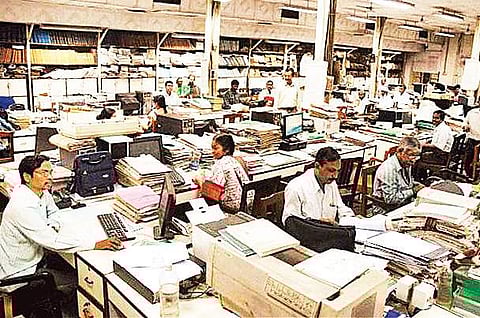

NEW DELHI: The government on Tuesday announced setting up the long-awaited 8th Central Pay Commission (CPC) with former Supreme Court Judge Justice Ranjana Prakash Desai as its Chairperson and IIM Bangalore Professor Pulak Ghosh as its member and Ministry of Petroleum and Natural Gas Secretary Pankaj Jain as the member-secretary. It has also approved the Terms of Reference for the panel, which has been given 18 months to submit its report.
Briefing media after the meeting of the Union Cabinet, chaired by Prime Minister Narendra Modi, Information Broadcasting Minister Ashwini Vaishnaw said, “The 8th Central Pay Commission will be a temporary body. The Commission will comprise one Chairperson; One Member (Part Time) and one Member-Secretary.”
The Minister went on to add that the panel would make its recommendations within 18 months of the date of its constitution and it might consider, “if necessary, sending interim reports on any of the matters as and when the recommendations are finalised.
On being asked about the delay in the formation of the panel and its Terms of Reference, as the government had in principle decided to constitute it in January this year, Vaishnaw said, “The Narendra Modi government has taken the decision in a record time, as it required wider consultations before finalising the ToR and the panel with a whole range of stakeholders, including large ministries like Defence, Home and Railaways, as well as the state government and employees Unions.”
The Minister said the government has finalised the commission’s composition, mandate and timelines, as it would submit its recommendations within 18 months and the revised pay structure is expected to come into force from January 1, 2026. He, however, said the implementation timeline will also be spelt out in the interim report of the panel.
The pay commission recommendations affect not just around 48 lakh central government employees and 67 lakh pensioners, but also influence compensation frameworks across state governments, public sector units, autonomous institutions and even private sector pay-benchmarking in some segments.
The previous 7th CPC was implemented in 2016. Since then, inflation, cost of living and consumption patterns have changed sharply, prompting long-pending demands from employee unions for a review.
Vaishnaw said the commission will examine existing salary slabs, allowances, grade pay structures, pension formulae and other financial components that shape government compensation.
The review is expected to take into account macroeconomic realities, fiscal considerations and employment competitiveness, he added.
In simpler terms, the pay panel will decide whether current pay levels are realistic and sustainable and what needs to be changed to maintain living standards and retain talent in the government service.
While employee representatives have been pushing for a more generous hike and revision of the minimum pay threshold, experts have pointed out that any huge jump will have fiscal implications, especially at a time when the government is balancing growth priorities, capital expenditure demands and welfare spending commitments.
Therefore, the 8th CPC panel will walk a tightrope, balancing employee expectations with the realities of the government resource.
However, the approval of the ToR marks the formal start of a process, which will shape government employees’ salary structures for the next decade. This will also affect household incomes, consumption trends and even savings behaviour across the country, particularly among nearly one crore government employees and pensioners.
Terms of reference:
While making the recommendations the panel needs to keep in view:
The economic conditions in the country and the need for fiscal prudence
Ensure adequate resources are available for developmental expenditure and welfare measures
Look at the unfunded cost of non-contributory pension schemes
Assess the likely impact of the recommendations on the finances of the State Governments
Take a view on the prevailing emolument structures available to employees of CPUs, private sector.