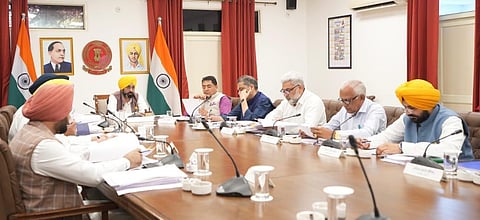

CHANDIGARH: The Punjab Cabinet on Tuesday approved the Punjab Unified Building Rules, 2025, which gives the nod for the construction of stilt-plus-four floors in all new buildings coming up in urban areas.
A decision to this effect was taken at a meeting of the Council of Ministers held here. Those having a minimum of 250 square yards of plot can go in for stilt-plus-four floors of construction. This will be allowed only in licenced colonies and sectors. A go-ahead has also been given for deemed approval of building plans for houses up to 250 square yards, while additional ground coverage has been allowed too.
The act aims to introduce a comprehensive and uniform regulatory framework governing building and development activities across Punjab. These rules apply equally to the Department of Housing and Urban Development and the Department of Local Government, ensuring consistency and simplification in approvals and enforcement. The key reforms focus on ease of doing business, efficient land utilization, and vertical urban growth.
The act stipulates raising the permissible height for low-rise buildings from 15m to 21m and enabling third-party self-certification for plan approval and completion, limiting scrutiny for high-rise projects to essential safety parameters, thereby reducing delays, allowing additional ground coverage and FAR on payment basis, and relaxing parking, setback, and open space norms.
It also includes incorporating EWS, affordable, and rental housing provisions within a single unified framework, introducing new building categories such as mixed land use and multilevel parking, aligning with modern urban needs. It permits wider balconies, basement use, car lifts, and exemptions from on-site STP where city-level facilities exist. These reforms represent a progressive step towards sustainable, investor-friendly, and standardized building regulation across Punjab.
Likewise, the cabinet also gave approval for rationalisation of stamp duty and registration fee on instruments of hypothecation and equitable mortgage by amending the Indian Stamp Act, 1899 (Punjab) and Registration Fee Rules. This step is a progressive and business-friendly initiative aimed at reducing financial burden on industries. It also promotes ease of doing business and improves access to affordable credit besides enhancing Punjab’s competitiveness and overall economic environment.
It has also been decided that no private person running drug rehabilitation centres will be allowed to run more than five of them. Presently, some of these people have been running over 20 centres. The cabinet also gave its concurrence to the Punjab Substance Use Disorder Treatment and Counselling and Rehabilitation Centres Rules, 2025, replacing the existing 2011 Rules and First Amendment Rules, 2020, to strengthen regulation of de-addiction and rehabilitation centres across Punjab.
These rules overcome the shortcomings in the 2011 rules and subsequent amendments in 2020 to regulate 36 government and 177 licensed private de-addiction centres, along with OOAT clinics. It will help in strengthening licensing, renewal, and inspection processes, biometric attendance and mandatory online data reporting, penal provisions for non-compliance or minor deficiencies, revised infrastructure, staff, and record-keeping standards and secure and transparent dispensing of buprenorphine–naloxone.
The cabinet also approved the filling up of 14 Group-A, 16 Group-B and 80 Group-C posts in the Punjab Sports Medical Cadre to strengthen the sports medical support system across districts. It will also help in improving injury management, recovery, and performance of sportspersons along with promotion of scientific sports development and alignment with national standards. These professionals will be deployed in major sports districts such as Patiala, Sangrur, Bathinda, Faridkot, Fazilka, Ludhiana, Amritsar, Gurdaspur, Jalandhar, SAS Nagar, Ropar and Hoshiarpur, where the concentration of players is higher.
The cabinet has also given its nod to turn Barnala into a municipal corporation from a municipal council city. "The way the city had expanded, industry developed and GST was generated, we have decided to make Barnala into a corporation. This will be the 14th corporation in the state," said CM Mann.
Further, the cabinet has given the green signal for a new sub tehsil in Ludhiana North, which will have four patwar sectors, one kanungo sector and seven villages.
