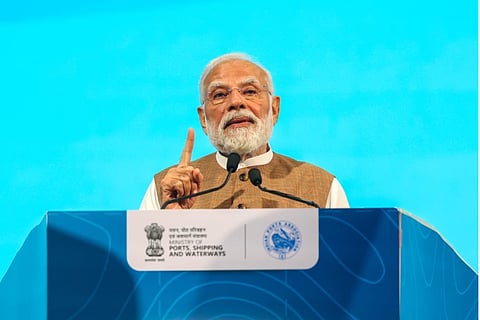

Prime Minister Narendra Modi on Wednesday said that in the 21st century, India’s maritime sector is advancing with great speed and energy, and it has replaced over a century-old colonial shipping laws with modern, tourist-friendly laws suited for the new era.
He said India has taken major steps toward next-generation reforms in the maritime sector. “India’s ports are now counted among the most efficient in the developing world, and in many cases, are outperforming ports in the developed world,” he said while addressing the Maritime Leaders Conclave in Mumbai. Modi chaired the Global Maritime CEO Forum at India Maritime Week 2025 in Mumbai, which saw participation from 85 countries, along with CEOs of major shipping giants, startups, policymakers, innovators, and representatives from small island nations.
Modi said that the land hosting the conclave is the land of Chhatrapati Shivaji Maharaj, who laid the foundation of maritime security and asserted Indian strength across the trade routes of the Arabian Sea. “Shivaji Maharaj’s vision highlighted that the seas are not boundaries but gateways to opportunity, and India is moving forward with the same thinking,” he said.
The Prime Minister announced that a new port is being constructed in Vadhavan, Maharashtra, for Rs 76,000 crore. He said India is working to quadruple the capacity of its major ports and increase its share in containerized cargo. The country permits 100 per cent FDI in ports and shipping, and public–private partnerships are rapidly expanding. Under the “Make in India, Make for the World” vision, incentives are being provided, and states are being encouraged to attract investments. “Investors from various countries should seize this moment to engage and expand in India’s shipping sector, as this is the right time,” he said.
“When the global seas are rough, the world looks for a steady lighthouse. India is well poised to play that role with strength and stability. Amid global tensions, trade disruptions, and shifting supply chains, India stands as a symbol of strategic autonomy, peace, and inclusive growth. India’s maritime and trade initiatives are integral to this broader vision. The India–Middle East–Europe Economic Corridor will redefine trade routes and promote clean energy and smart logistics,” Modi said.
He said the Vizhinjam Port, India’s first deep-water international transshipment hub, is now operational, and the world’s largest container vessel recently arrived there, marking a proud moment for the country. In 2024–25, India’s major ports have handled their highest-ever cargo volumes, setting a new record.
For the first time, an Indian port has launched a megawatt-scale indigenous green hydrogen facility, an achievement credited to Kandla Port. Phase 2 of the Bharat Mumbai Container Terminal at JNPT has also commenced, doubling the terminal’s handling capacity and making it India’s largest container port. Modi said this was made possible due to the largest FDI in India’s port infrastructure and expressed gratitude to partners from Singapore for their contribution.
He said the new Merchant Shipping Act has aligned Indian laws with international conventions, enhancing trust in safety standards, improving ease of doing business, and reducing government intervention. The Coastal Shipping Act, he said, has been designed to simplify trade and strengthen supply chain security while ensuring balanced development along India’s extensive coastline. Highlighting the “One Nation, One Port Process,” Modi said it will standardize port-related procedures and significantly reduce documentation requirements.