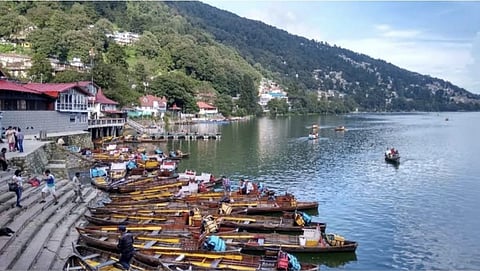

NAINITAL: Despite the state government’s efforts to boost tourism under the ethos of “Atithi Devo Bhava” (The Guest is God), the lake town of Nainital is failing to draw back its once-flourishing community of foreign visitors.
Once a premier destination known for its serene lake, stunning natural beauty, and tranquil atmosphere, Nainital is now grappling with a noticeable slump in international footfall. Just a few years ago, foreign tourists were a common sight strolling through the bustling markets of Mallital and Tallital, enjoying boat rides, or simply soaking in the lakeside vistas. Today, those same lanes seem to yearn for that.
“The number of foreign tourists has significantly dropped over the past few years,” noted one long-time hotelier. “Where every hotel used to host international guests during the peak season, bookings are now negligible.” Many international travelers, it appears, are opting for alternative destinations like Himachal Pradesh, Ladakh, or locations in South India.
Furthermore, perennial issues within Nainital, such as crippling traffic jams, limited parking facilities, and overcrowding, are reportedly making the experience inconvenient for overseas visitors. Tourism experts stress the urgent need for the city to adopt a ‘Sustainable Tourism Model’ if it hopes to see global visitors return.

Nainital’s relationship with tourism stretches back to its very inception as a settlement in the 19th century. Professor Ajay Rawat, a renowned historian based in Nainital, shared his insights with this paper.
“Tourism in Nainital began in the 19th century when urbanization started in 1841. At that time, the town gained popularity as a health resort,” Professor Rawat explained. “English residents stationed in the plains would visit Nainital to recuperate. Later, towards the end of the 20th century, Mary Jim Corbett, mother of the famous hunter Jim Corbett, gave tourism a new dimension.”
He detailed how World War I temporarily halted the influx, but tourism boomed again afterward. After World War II, the town hosted Royal Air Force personnel. The presence of war graves of British soldiers also attracted their families here.
However, according to critics, governmental apathy has nearly extinguished international tourism here.