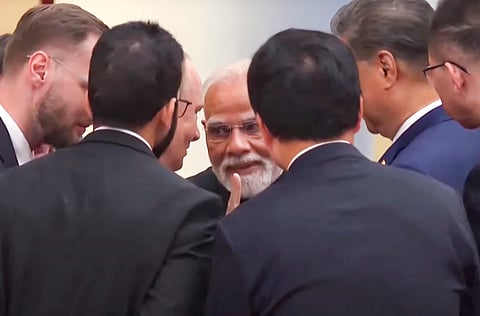

NEW DELHI: With Pakistan Prime Minister Shehbaz Sharif in attendance, Indian Prime Minister Narendra Modi on Monday used the Shanghai Cooperation Organisation (SCO) summit to deliver a pointed warning against cross-border terrorism, calling the recent Pahalgam terror attack “an open challenge to every country that believes in humanity.”
Without naming Pakistan directly, Modi condemned “open support for terrorism by some countries” and urged SCO member states to take an unambiguous stand. “No double standards on terrorism will be acceptable,” he said, warning that the menace must be opposed “in all its forms and colours.” The comments come amid renewed concerns in India over Pakistan-based terror networks and their transnational enablers.
“For the past four decades, India has been bearing the grave scars of ruthless terrorism. Countless mothers have lost their children, and innumerable children have been left orphaned,” Modi said adding that the “ugly face of terrorism” was once again visible in the Pahalgam attack, which claimed the lives of 26 innocent tourists in April.
“We saw a very heinous form of terrorism in Pahalgam. I express my gratitude to the friendly countries who stood with us in this hour of grief. This attack was not only a blow to the conscience of India, it was an open challenge to every country and every person who believes in humanity,” Modi said.
The SCO summit’s joint declaration later echoed Modi’s tone, with member states condemning the Pahalgam attack and calling for the perpetrators to be brought to justice. It also mentioned two terror attacks in Pakistan.
“We must state it clearly and in one voice: double standards on terrorism are unacceptable. Together, we must oppose terrorism in every form and manifestation. This is our responsibility towards humanity,” Modi said.
While terrorism dominated Modi’s address, the Indian leader also delivered a veiled message on sovereignty concerns in regional connectivity projects, a likely reference to the China-Pakistan Economic Corridor (CPEC), which runs through Pakistan-occupied Kashmir (PoK). Without naming any initiative, Modi said connectivity must be based on “respect for the sovereignty and territorial integrity of all member states,” a long-standing Indian position that implicitly critiques China’s Belt and Road projects passing through disputed territory.
“We believe that every effort towards connectivity must uphold the principles of sovereignty and territorial integrity. This is also enshrined in the core principles of the SCO Charter. Connectivity, that by-passes sovereignty, ultimately loses both trust and meaning,” Modi said.
Russian President Vladimir Putin blamed NATO expansion and what he called the 2014 “coup in Kiev” as root causes of the Ukraine conflict. Chinese President Xi Jinping, meanwhile, took aim at “bullying behaviour” in the global order, calling for a rejection of bloc politics and Cold War mentalities, a stance widely interpreted as criticism of US dominance.