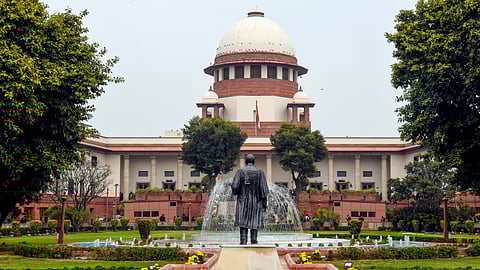

NEW DELHI: The Supreme Court, on the sixth day of hearing in the Presidential Reference case, on Tuesday asked the parties what would be the consequences if the Governor or the President did not follow the timeline prescribed by it in its 8 April verdict.
"Can the Governor or the President be hauled up for contempt of court if they will not follow the April 8 verdict?" the top court asked. To this, one of the respondents, the Tamil Nadu government, through its lawyer Abhishek Manu Singhvi, replied that "deemed assent" to the Bills can be a consequence.
The apex court also observed that certain instances of delay in granting assent to Bills cannot justify the laying down of a blanket timeline for the Governors and President to act as per Articles 200 and 201 of the Constitution respectively.
"If there are individual cases of delay, the aggrieved parties can approach the Court to seek relief, and the Court may direct that the decision should be taken within a time limit; however, it cannot mean that the Court should lay down a general timeline for the actions of the Governor and the President," the five-judge Constitution Bench, headed by Chief Justice of India B R Gavai, said orally.
Singhvi argued that the timelines were necessary in view of the repeated instances of Governors withholding Bills indefinitely.
The top court was hearing a Presidential Reference that questions its 8 April judgement, which prescribed timelines for the President and the Governor to decide on Bills.
Singhvi submitted to the apex court that killing of a Bill is available only to the Cabinet and nobody else. "It cannot be by Governor. Your Lordship will have no scheme of Constitution left if that is allowed," he added.
Singhvi further contended that a Governor cannot be the final arbiter of a Bill. "Governor cannot withhold assent, kill a Bill or be a judge in this. He is not the final arbiter or the Super Chief Minister. Ultimately, alleged unconstitutional Bills are passed every day and courts will decide that. Even if majority introduced it, courts will see it... that is separation of powers," he said.
The argument, which was inconclusive on Tuesday, would continue on Wednesday.
The Court also questioned whether the Court can grant deemed assent for Bills not acted upon by the Governor.
"This Court can just get into the shoes of the Governor and consider all three options he [Governor] has...?" the Court asked.
To this, Singhvi replied that if Governors and the President are exempt from judicial review, then their jurisdiction of power is stretched beyond limits.
Defending the timelines set for Governors and the President, Singhvi said Article 200’s structure is amenable to timelines. "The Governor is to take a decision within a reasonable time period," he stated.
After hearing this, CJI Gavai said there could be different factual considerations in different cases and asked how there can be the same timeline for all Bills.
It expressed doubt over the Court's power to fix timelines for the Governor.
Singhvi argued that the timelines set by the Supreme Court were necessary in view of the repeated instances of Governors withholding Bills indefinitely.
The Court observed that laying down a general timeline will practically amount to the Court amending the Constitution, since Articles 200 and 201 do not specify any timeline. "We will have to amend the Constitution to impose the timelines," Justice Vikram Nath said.
Singhvi said that if the State has to approach the Court every time the Governor refuses to act on the Bills, it will only add to the delay.
The five-judge Constitution Bench hearing the Presidential Reference case was headed by CJI Gavai and four other senior-most judges of the Supreme Court, comprising Justices Surya Kant, Vikram Nath, P S Narasimha and A S Chandurkar.
Earlier on 8 April, a two-judge Bench of the Supreme Court comprising Justices J B Pardiwala and R Mahadevan, while hearing the case of State of Tamil Nadu against Governor of Tamil Nadu, held that the State Governor must act within three months if withholding assent or reserving a Bill, and within one month when a Bill is re-enacted. It also prescribed that the President should decide on the Bills reserved for her consideration by the Governor within three months from the date on which such a reference is received.
Challenging this verdict, President Murmu had moved the top court on 13 May, with 14 crucial questions raised by her in the Presidential Reference challenging the Supreme Court's 8 April verdict that fixed timelines for Governors and the President to act on Bills passed by State Assemblies.
President Murmu, while exercising her power under the rarely used Article 143 (1), moved the apex court and said that in the present circumstances, it appeared that 14 questions of law have arisen and they are of such nature and public importance that it is expedient to obtain the opinion of the Supreme Court.
Out of 14 crucial questions, the majority and most important were as follows:
What are the constitutional options before a Governor when a Bill is presented under Article 200 of the Constitution of India?
Is the Governor bound by the aid and advice tendered by the Council of Ministers while exercising all options available with him when a Bill is presented before him under Article 200 of the Constitution of India?
Is the exercise of constitutional discretion by the Governor under Article 200 of the Constitution of India justiciable?
Is Article 361 of the Constitution of India an absolute bar to judicial review in relation to the actions of a Governor under Article 200 of the Constitution of India?
In the absence of a constitutionally prescribed time limit, and the manner of exercise of powers by the Governor, can timelines be imposed and the manner of exercise be prescribed through judicial orders for the exercise of all powers under Article 200 of the Constitution of India by the Governor?
Earlier on 22 July, the top court had agreed to examine President Droupadi Murmu's reference on 14 questions on the issue of timelines prescribed by it to State Governors and the President while dealing with the Bills passed by the Assembly.